
 Tiếng Việt
 日本語
日本語
ISO 13485 medical devices is the standard every contract manufacturer claims to follow — but not every manufacturer follows it equally well. Before signing with your next EMS partner, here is what you actually need to verify.
ISO 13485 Medical Devices — What the Standard Actually Requires
A Quick Overview for OEMs
ISO 13485:2016 is the internationally recognized Quality Management System (QMS) standard designed specifically for organizations involved in the design, development, production, installation, and servicing of medical devices.
Every requirement in the standard traces back to one principle: consistent product safety and effectiveness for the end patient.
Key facts every OEM must know before engaging a manufacturer:
- Certification is voluntary — no universal law mandates ISO 13485, but it is a de facto market requirement for FDA (USA), EU MDR (Europe), Health Canada, and most major procurement bodies
- Certification is valid for 3 years, with surveillance audits conducted at regular intervals to verify ongoing compliance — not just at recertification
- Scope varies by manufacturer — a certificate may cover only part of a facility’s operations, not all processes your device requires
- Sub-suppliers are not automatically covered — your EMS partner’s certification does not extend to their component vendors unless actively managed
ISO 13485 vs ISO 9001 — The Differences That Matter for OEMs
Many contract manufacturers hold both ISO 9001 and ISO 13485. While ISO 13485 was built upon ISO 9001’s foundation, the two standards are not interchangeable. Understanding the gap is critical when qualifying an EMS partner for ISO 13485 medical devices production.
| Requirement | ISO 9001 | ISO 13485 |
|---|---|---|
| Process Validation | Risk-based approach | Mandatory for specified processes |
| Design Documentation | General requirements | Comprehensive Design History File (DHF) |
| Traceability | Customer requirements | Device-specific, component-level traceability |
| Change Control | Documented procedures | Formal change control with validation |
| Supplier Control | Risk-based evaluation | Comprehensive supplier qualification |
| Post-Market Surveillance | Not required | Mandatory — complaint handling & CAPA |
| Risk Management | General | Lifecycle-wide, aligned with ISO 14971 |
ISO 9001 tells you a manufacturer has a quality system. ISO 13485 tells you that system is built specifically for medical devices — with the regulatory rigor that patient safety demands.
Why an ISO 13485 Certificate Is Not Enough
The Gap Between Holding a Certificate and Living the Standard
This is the most important section of this guide.
An ISO 13485 certificate confirms a manufacturer had a compliant QMS at the time of their last audit. It does not confirm the QMS is actively followed on the production floor today — and it does not confirm the certified scope covers the specific processes your device requires.
One critical detail many OEMs overlook: some manufacturers are certified “without Design.” This means their ISO 13485 medical devices scope explicitly excludes design and development activities. If your device requires design collaboration or design transfer support, a “without Design” certificate is a significant disqualifier.
“An ISO 13485 certificate tells you a manufacturer has a QMS. It does not tell you how well they run it.”
Real-world consequences of choosing the wrong partner:
- FDA audit failure during 510(k) review or pre-approval inspection
- EU MDR Technical Documentation rejection by a Notified Body
- Product recall due to undocumented process changes
- Liability exposure from inadequate traceability records
Working with a manufacturer whose ISO 13485 certified PCB assembly process is fully documented and audit-ready eliminates these risks before they become costly.
The 6-Point OEM Qualification Checklist for ISO 13485 Medical Devices Manufacturers
Before signing any contract manufacturing agreement, run every candidate through this checklist.
1. Verify the Exact Scope of Certification
Request the original certificate document — not just a logo on a website. The scope statement specifies exactly which processes, product types, and facility locations are covered under the manufacturer’s ISO 13485 medical devices certification.
Ask directly:
- Does your ISO 13485 scope include PCB assembly and final device assembly?
- Does your scope include or exclude Design and Development?
- Which specific facility locations are covered?
A reputable manufacturer shares this document without hesitation. Hesitation itself is a data point.
2. Assess Traceability Systems
ISO 13485 Section 7.5.9 mandates component-level traceability throughout the entire supply chain. Every component used in your device must be trackable from the original supplier through to the finished product and out to the end customer.
Ask your candidate:
- How do you track components from incoming inspection to finished goods?
- What is your system for managing lot numbers and date codes?
- How quickly can you produce a full traceability report for a specific device serial number?
Manufacturers without a robust digital traceability system — not just paper records — are a liability in any FDA or EU MDR audit scenario.
3. Review Design History File (DHF) Capability
If your engagement requires design collaboration or design transfer, your EMS partner must have a documented Design History File (DHF) process aligned with ISO 13485 Section 7.3.
The DHF must capture: design inputs, design outputs, design reviews, verification results, validation results, and design transfer records. This is a core FDA requirement under 21 CFR Part 820 and a cornerstone of EU MDR Technical Documentation.
4. Confirm Risk Management Integration
ISO 13485 medical devices requirements mandate risk management embedded throughout the entire product lifecycle — not treated as a one-time exercise at project kickoff. This is typically implemented in alignment with ISO 14971, the international standard for medical device risk management.
During qualification, ask:
- How do you integrate risk management into your production process changes?
- Can you show your risk management procedure documentation?
- How do you handle risk re-evaluation when a component becomes obsolete?
A manufacturer who cannot answer these questions fluently has a QMS that exists on paper, not in practice.
5. Evaluate Supplier Control Procedures
Your EMS partner’s ISO 13485 certification does not automatically extend to their sub-suppliers. The standard requires manufacturers to maintain an Approved Supplier List (ASL) and conduct regular supplier qualification and re-evaluation.
This matters enormously for medical-grade component sourcing. A single unqualified component from an unapproved supplier can invalidate your device’s regulatory submission.
Ask:
- How do you qualify new suppliers for medical-grade components?
- How often do you re-evaluate existing suppliers?
- What happens when a preferred component is discontinued?
6. Check Post-Market Surveillance and CAPA Support
Manufacturing does not end at shipment. ISO 13485 medical devices compliance requires manufacturers to support Corrective and Preventive Action (CAPA) processes and complaint handling after products reach the market.
A strong EMS partner must be able to:
- Participate in root cause analysis for field complaints
- Provide manufacturing records to support MDR (Medical Device Reporting) submissions
- Implement and document process corrections with full validation evidence
This level of post-market partnership is what separates a true medical device contract manufacturer from a commodity PCB assembler.
How ISO 13485 Medical Devices Standards Align with Global Regulations
ISO 13485 and FDA 21 CFR Part 820
The U.S. FDA updated 21 CFR Part 820 — the Quality System Regulation — effective February 2026, aligning it more closely with ISO 13485:2016. Manufacturers already compliant with ISO 13485 medical devices requirements have a significantly smoother path to FDA compliance as a result.
However, ISO 13485 certification alone does not satisfy FDA registration requirements. OEMs selling into the US market still need:
- FDA Establishment Registration
- Device Listing
- 510(k) clearance or PMA approval depending on device class
ISO 13485 and EU MDR 2017/745
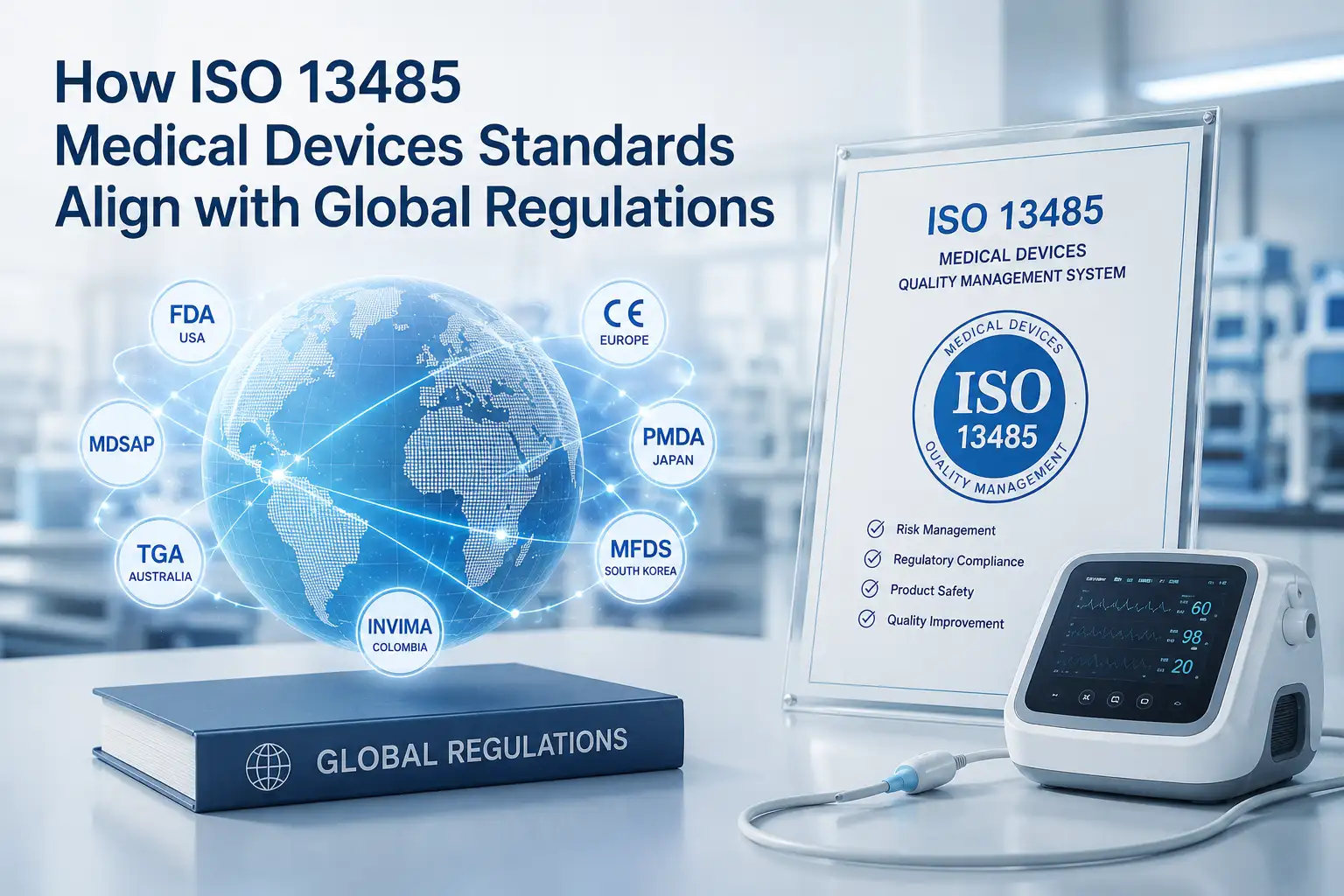
Under the EU Medical Device Regulation (MDR) 2017/745, ISO 13485 is the only QMS standard recognized for medical device manufacturers seeking CE marking. Manufacturers outside the EU — including those in Vietnam — must also appoint an Authorized Representative within the EU as part of the MDR compliance pathway.
The MDSAP Advantage
The Medical Device Single Audit Program (MDSAP) allows a single audit to satisfy QMS requirements for five regulatory authorities simultaneously: FDA (USA), Health Canada, TGA (Australia), ANVISA (Brazil), and PMDA (Japan). OEMs working with MDSAP-certified manufacturers gain significant efficiency in multi-market regulatory submissions.
ISO 13485 Medical Devices Manufacturing in Vietnam — What OEMs Need to Know in 2026
The China+1 manufacturing strategy has accelerated significantly through 2025–2026, with US and EU medical device OEMs actively evaluating Vietnam as a credible alternative to China-based EMS partners.
Vietnam offers a compelling combination for ISO 13485 medical devices manufacturing:
- Competitive cost structure — 20–35% lower labor costs than comparable China-based EMS
- Growing engineering talent pool — particularly strong in electronics and precision manufacturing
- Improving regulatory infrastructure — Vietnam’s Ministry of Health progressively aligning with international medical device standards
- Favorable trade agreements — CPTPP and EVFTA provide preferential tariff access to key markets
However, OEMs must apply the same rigorous qualification process outlined above. Not all Vietnam-based EMS providers hold ISO 13485 certification with full medical device scope — the 6-point checklist in this guide applies equally, and perhaps more critically, when evaluating offshore manufacturing partners.
SHDC manufacturing facility in Vietnam combines full-scope QMS compliance with IPC Class 3 assembly capability, component-level traceability, and dedicated support for FDA and EU MDR documentation requirements — purpose-built for medical device OEMs requiring offshore manufacturing without regulatory compromise.
Key Takeaways — Choosing the Right ISO 13485 Medical Devices Manufacturer
ISO 13485 medical devices certification is the starting point of your evaluation, not the finish line. Here is what every OEM must remember:
- Verify the scope — confirm the certificate covers your specific processes and facility
- Test the traceability system — demand a live demonstration, not a brochure
- Confirm DHF capability — especially if design collaboration is part of the engagement
- Probe risk management — a QMS that cannot explain ISO 14971 integration is incomplete
- Audit supplier controls — your partner’s supply chain is your supply chain
- Expect post-market support — CAPA and complaint handling capability is non-negotiable
The right contract manufacturer does not just hold a certificate — they live the ISO 13485 medical devices standard in every process, every batch record, and every supplier interaction.
Ready to evaluate your next ISO 13485 medical device manufacturing partner? Contact SHDC for a qualification consultation and facility audit review — no obligation.
