
 Tiếng Việt
 日本語
日本語
When a pacemaker fails in the field, engineers don’t have weeks to investigate — they have hours. When an industrial motor controller causes a production line shutdown, the root cause must be isolated before the next shift begins. In both scenarios, the difference between a targeted corrective action and a full-scale recall comes down to one capability: traceability in electronics manufacturing. Traceability is no longer a differentiator that separates premium EMS providers from average ones. Under EU MDR, ISO 13485, and IATF 16949, it is a regulatory baseline — and for U.S. and European OEMs building medical or industrial electronics, it is increasingly a contract requirement before a supplier relationship even begins. This guide covers what traceability actually means at the component level, which standards require it, how it works inside a modern EMS factory, and — critically — what questions to ask your contract manufacturer before you commit.
Main content
ToggleWhat Is Traceability in Electronics Manufacturing?
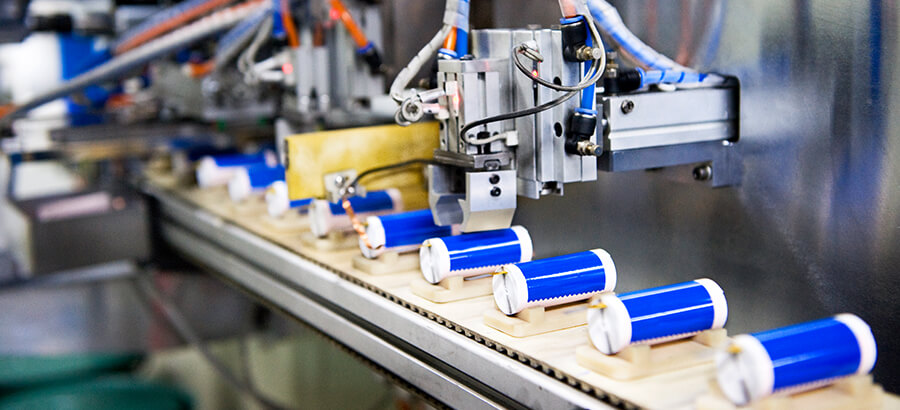
Traceability, in its simplest form, is the ability to reconstruct the complete history of a product — every component used, every process step performed, every operator involved, and every test result recorded — from a single identifier such as a board serial number or lot code.
In practice, this capability exists at three distinct levels, each with different regulatory implications.
Component-Level vs. Board-Level vs. Lot-Level Traceability
| Level | What It Tracks | Typical Application |
|---|---|---|
| Lot-Level | Batch of components → production run | Basic quality management, low-risk products |
| Board-Level | Individual PCB → full production history | Industrial, automotive, defense |
| Component-Level | Every component → exact board location, reel ID, operator, timestamp | Medical devices, aerospace, Class III electronics |
For medical and industrial OEMs, board-level traceability is the minimum — and component-level traceability is rapidly becoming the standard expectation across regulated industries.
What a Full Traceability Chain Looks Like
A complete traceability chain follows every board through the entire production flow — from the moment components arrive at the warehouse to the moment finished goods leave the facility:
- IQC (Incoming Quality Control): Component reels logged with supplier lot numbers, date codes, and Certificate of Conformance references
- SMT Placement: Each placement event recorded — reel ID, machine ID, nozzle ID, timestamp, operator
- Reflow: Oven profile data (temperature curve, zone settings) linked to board serial number
- AOI / SPI Inspection: Defect images and pass/fail results stored against board serial
- DIP / Wave Soldering: Flux type, solder bath temperature, conveyor speed — all logged per production run
- ICT / FCT Testing: Every test result, including parametric data, tied to individual board serial
- OQC & Packaging: Final inspection result, carton ID, and shipment reference — all linked
The result: when a field failure occurs, an EMS partner with full traceability can reconstruct the complete production history of that specific board in under 10 minutes — not days, not weeks.
At SHDC, this chain is managed through the AIT Tracer system, integrated with Yamaha’s YSUP / iProDB production management platform, ensuring every data point from SMT placement through final OQC is captured digitally and retrievable on demand. Learn more about SHDC’s full-service EMS capabilities.
Why Traceability Matters: The Regulatory and Business Case
Traceability requirements didn’t emerge from best-practice guidelines — they were written into law following high-profile device failures and supply chain scandals that exposed the cost of not knowing where every component came from.
Medical Device Requirements
The regulatory framework for medical electronics traceability is now among the most demanding in manufacturing:
- EU MDR (2017/745) Article 27: Unique Device Identification (UDI) system mandatory for all medical devices placed on the EU market — every device must carry a UDI that links back to full production documentation
- FDA 21 CFR Part 820.65: Traceability required for any device or component where mix-up could cause harm — Device History Records (DHR) must be maintained for each production unit
- ISO 13485:2016 Section 7.5.9: Traceability is an explicit mandatory requirement, not an optional quality enhancement — the standard requires documented procedures defining the extent of traceability
The consequence of non-compliance is severe: without component-level traceability, a single field failure can trigger a recall of the entire production lot rather than only the affected serial numbers.
For OEMs manufacturing medical device electronics in Vietnam, selecting an EMS partner with ISO 13485-aligned traceability processes is not optional — it is a prerequisite for regulatory approval.
Industrial and Automotive Requirements
The industrial and automotive sectors operate under equally rigorous frameworks:
- IPC-A-610 (Acceptability of Electronic Assemblies): Audit trail requirements are embedded throughout — traceability data must be available for any nonconformance investigation
- IATF 16949 (Automotive Quality Management): PPAP (Production Part Approval Process) submissions require full component traceability documentation; Control Plans must specify traceability methods
- IPC-7711/7721 (Rework and Repair): Any rework performed must be documented and traceable to the original board record
SHDC’s production of automotive PCBA for Thaco — one of Vietnam’s largest automotive groups — is conducted under PPAP-level documentation standards. See SHDC’s automotive PCBA capabilities.
The Business Case Beyond Compliance
Even outside regulated industries, traceability delivers measurable operational value:
- Faster root cause analysis: Field failure investigations that previously took 2–4 weeks can be completed in hours when full production data is available
- Targeted recall vs. blanket recall: With component-level traceability, only boards containing the affected component reel need to be recalled — potentially reducing recall scope by 90%+ and saving millions in replacement and logistics costs
- Supplier accountability: When a component failure is traced to a specific supplier lot, warranty claims and corrective action requests are backed by data rather than assumption
- Customer confidence: Medical and industrial OEMs increasingly require traceability reports as a standard deliverable — not just during audits, but as part of routine shipment documentation
Traceability Standards: What the Regulations Actually Require
Understanding the specific clauses that govern traceability helps OEMs write better supplier requirements — and helps EMS providers demonstrate compliance with precision.
Medical: ISO 13485 and EU MDR
| Standard / Regulation | Key Clause | Traceability Requirement |
|---|---|---|
| ISO 13485:2016 | Section 7.5.9 | Documented traceability procedures; scope defined by regulation or customer requirement |
| EU MDR 2017/745 | Article 27 + Annex VI | UDI assignment; technical documentation; post-market surveillance data linkage |
| FDA 21 CFR Part 820 | Section 820.65 | Device History Record (DHR) for each production unit; component traceability where mix-up risk exists |
| FDA 21 CFR Part 820 | Section 820.184 | DHR must include dates of manufacture, quantity, acceptance records, labels |
The critical point: ISO 13485 does not specify how traceability must be implemented — it specifies that it must exist and be documented. This means an EMS partner using paper-based records technically complies, but practically fails when a real investigation is needed.
Industrial: IPC Standards
- IPC-A-610 Rev. H: Defines acceptability criteria for electronic assemblies; traceability records are required for Class 3 (high-reliability) products
- IPC-2581: Digital product model standard — defines how traceability data should be structured and transferred between OEM and EMS
- IPC-7711/7721: All rework and repair operations must be documented with reference to the original board record and the operator performing the work
Automotive: IATF 16949
- PPAP Level 3 submission requires: Part Submission Warrant, Design Records, Process Flow Diagram, Control Plan, and — critically — full component traceability documentation
- Control Plan: Must specify the traceability method for each process step, including how nonconforming material is identified and segregated
- 8D Problem Solving: Effective 8D reports require traceable production data to complete D4 (Root Cause) and D5 (Corrective Action) with evidence
For a deeper look at how SHDC approaches quality documentation, see how to evaluate a PCB fabrication factory.
External reference: Assele EMS: A Strategic Guide to Traceability in Electronic Manufacturing Services 2026
How Traceability Works in Practice: Inside a Digital EMS Factory

Understanding traceability in theory is straightforward. Understanding how it actually functions inside a production environment — and what separates a genuinely traceable factory from one that merely claims to be — requires looking at the technology stack and the data flow.
The Technology Stack That Makes Traceability Real
| System | Role in Traceability | At SHDC |
|---|---|---|
| MES (Manufacturing Execution System) | Real-time production tracking; operator log; machine data capture | AIT Tracer Server integrated with Yamaha YSUP |
| QMS (Quality Management System) | Inspection results; NCR records; corrective action tracking | Integrated QC/QA workflow across IQC → OQC |
| ERP | Component lot numbers; PO history; supplier data; inventory linkage | ERP system managing PMC, Purchasing, and Logistics |
| AOI / SPI Systems | Automated optical inspection data; 3D solder paste inspection | Yamaha YSI-V 3D AOI + Yamaha YSI-SP 3D SPI |
| ICT / FCT | In-circuit and functional test results per board serial | Kyoritsu ICT F-2000 Plus; dedicated FCT stations |
SHDC operates 4 high-speed SMT lines with Yamaha YSM20R and YSM10 mounters, 3 DIP lines, and dedicated test and assembly lines — all integrated into the AIT Tracer production management system. Total monthly SMT capacity: 140,000,000 points/month.
What a Traceability Query Looks Like in Practice
When an OEM submits a field failure report with a board serial number, here is what happens inside a properly configured EMS traceability system:
Step 1 — Serial Number Query (< 1 minute) System retrieves: production date, shift, line number, operator IDs at each station
Step 2 — Component Identification (< 3 minutes) System identifies: every component reel used on that board, including reel ID, supplier lot number, date code, and placement position
Step 3 — Cross-Reference (< 5 minutes) System queries: how many other boards used the same component reel? What are their serial numbers? Where are they in the supply chain — in stock, in transit, or already delivered?
Step 4 — Output (< 10 minutes total) Complete affected serial number list → targeted corrective action, targeted recall if necessary
Without MES-integrated traceability, this same process requires manual record reconstruction across paper logs, spreadsheets, and operator interviews — typically taking 2 to 4 weeks, with significant risk of incomplete data.
This is the operational reality that separates a traceable EMS partner from one that simply has a quality certificate on the wall.
What to Demand From Your EMS Partner: A Traceability Checklist
Before awarding a contract for medical or industrial electronics manufacturing, use this checklist to evaluate your EMS partner’s traceability capability. This is not a comprehensive audit — it is a minimum qualification filter.
EMS Partner Traceability Evaluation Checklist
Component-Level Tracking
- Every component is tied to a board serial number, reel ID, and placement timestamp
- Reel IDs are linked to supplier lot numbers and date codes in the IQC system
- Component substitutions (approved alternates) are documented and traceable
MES Integration
- Production data is captured in real time — not reconstructed from paper records after the fact
- Machine data (placement, reflow, wave solder parameters) is automatically logged
- Operator IDs are recorded at each production step
Digital Audit Trail
- Full production history is retrievable by serial number in under 10 minutes
- Data is stored in a structured database — not spreadsheets or scanned paper
- Audit trail is tamper-evident and access-controlled
Inspection and Test Data
- AOI, SPI, ICT, and FCT results are stored per board serial number
- Parametric test data (not just pass/fail) is retained
- Repair records are linked to original board serial and include operator ID and repair method
Nonconformance Tracking
- NCR (Nonconforming Record) system links defects to specific board serials, component lots, and process steps
- Corrective actions are documented with root cause evidence
- Affected serial number lists can be generated from any NCR
Data Retention
- Medical device records retained for minimum 10 years (EU MDR requirement)
- Automotive records retained per customer-specified period (typically 15 years)
- Data backup and disaster recovery procedures are documented
Customer Access
- OEM can receive traceability reports as standard shipment documentation
- Traceability data format is compatible with OEM’s quality management system
- Emergency traceability queries (field failures) are responded to within agreed SLA
Recall Simulation Capability
- EMS partner has conducted mock recall drills
- Can demonstrate isolation of affected serial numbers within 24 hours
- Has documented recall response procedure with defined roles and timelines
For a broader evaluation framework, see how to evaluate a PCB fabrication factory and 10 reasons to choose contract electronics manufacturing in Vietnam.
Traceability at SHDC: Built Into Every Production Step
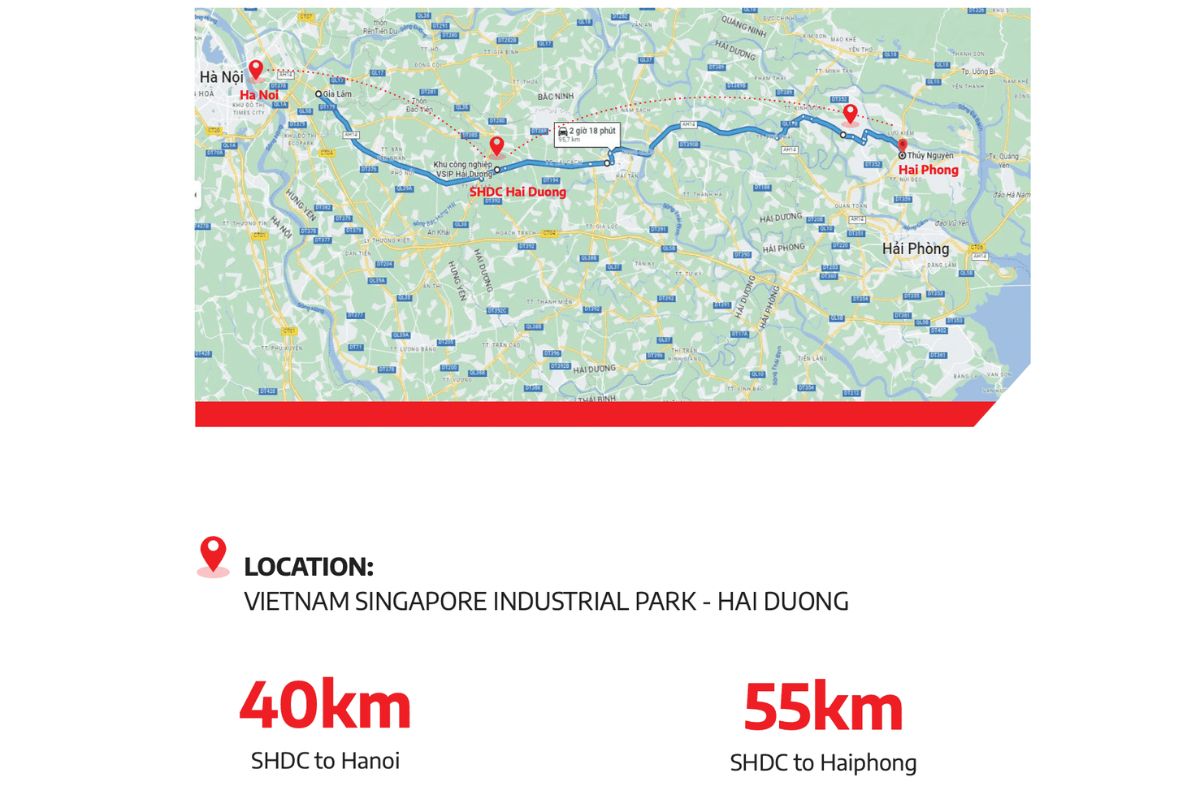
SHDC Electronics, located in the Vietnam Singapore Industrial Park — Hai Duong, 40km from Hanoi and 55km from Haiphong Port, operates a 2,600 m² facility with 150 employees across SMT, DIP, assembly, test, and quality functions.
Traceability at SHDC is not a documentation exercise — it is embedded into the production infrastructure:
Production Traceability Infrastructure
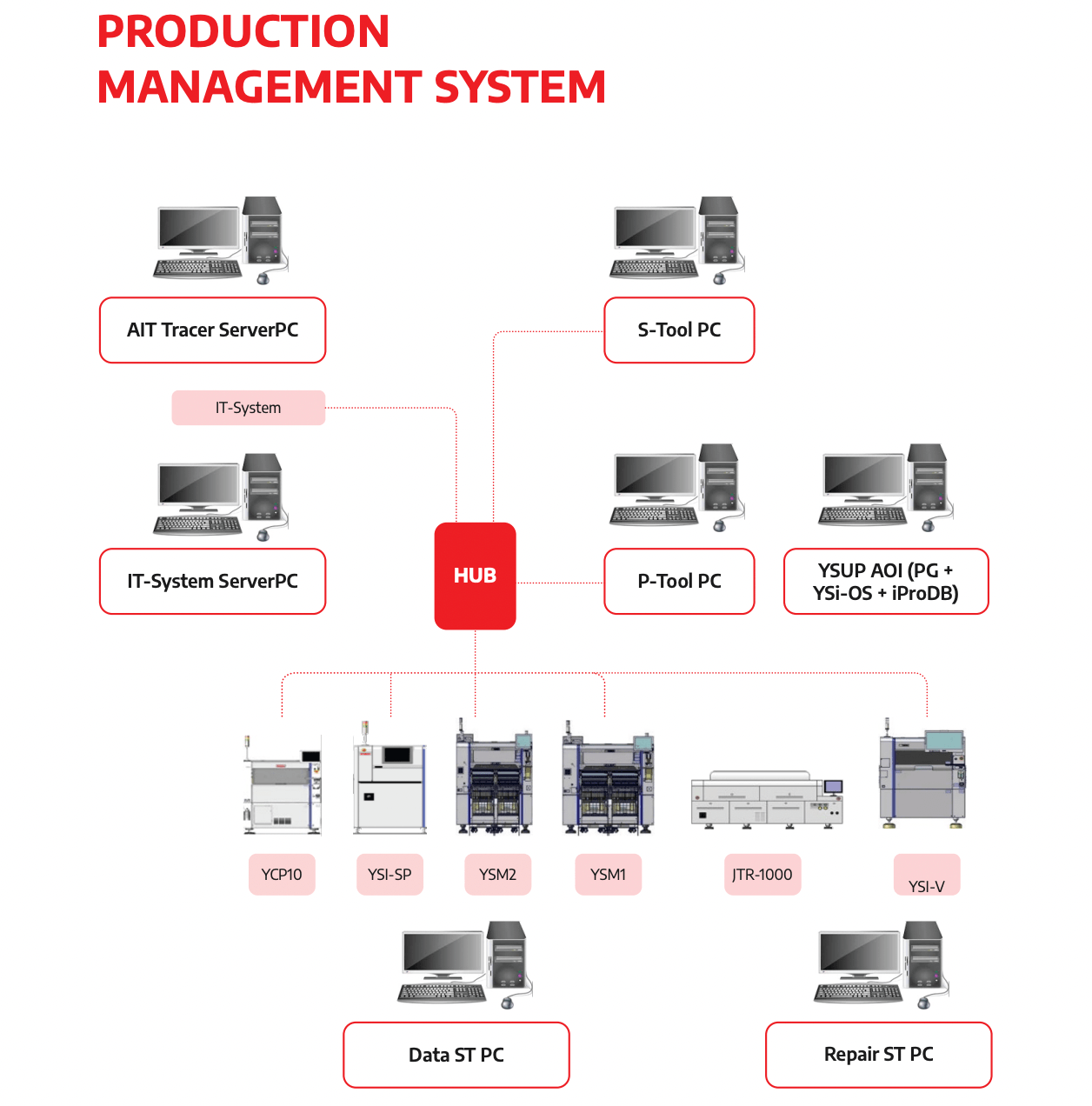
AIT Tracer System SHDC’s AIT Tracer ServerPC integrates with the full Yamaha production management ecosystem (YSUP, iProDB, YSI-OS), creating a continuous digital thread from component receipt through final shipment. Every board that passes through SHDC’s SMT lines carries a traceable identity from the moment it enters the production flow.
Yamaha Smart Factory Integration SHDC’s Yamaha YSM20R (95,000 CPH, ±0.03mm placement accuracy) and YSM10 mounters feed placement data directly into the YSUP platform. The Yamaha YSI-SP 3D SPI and Yamaha YSI-V 3D AOI systems generate inspection records that are automatically linked to board serial numbers — no manual data entry, no transcription errors.
ICT and Functional Testing The Kyoritsu ICT F-2000 Plus system records parametric test data per board serial. FCT stations capture functional performance data. Aging test results, high-voltage test records, and AV test data are all retained in the quality management system.
ERP + MES + QMS Integration SHDC operates an integrated ERP / PLM / SCM / MES / QMS digital management system. According to SHDC’s production management data, this integration reduces decision-making time by 30% and reduces defective inventory by 30% — direct outcomes of real-time data visibility across the production chain.
Proven in Regulated and High-Reliability Applications
SHDC’s traceability capability has been validated across demanding production programs:
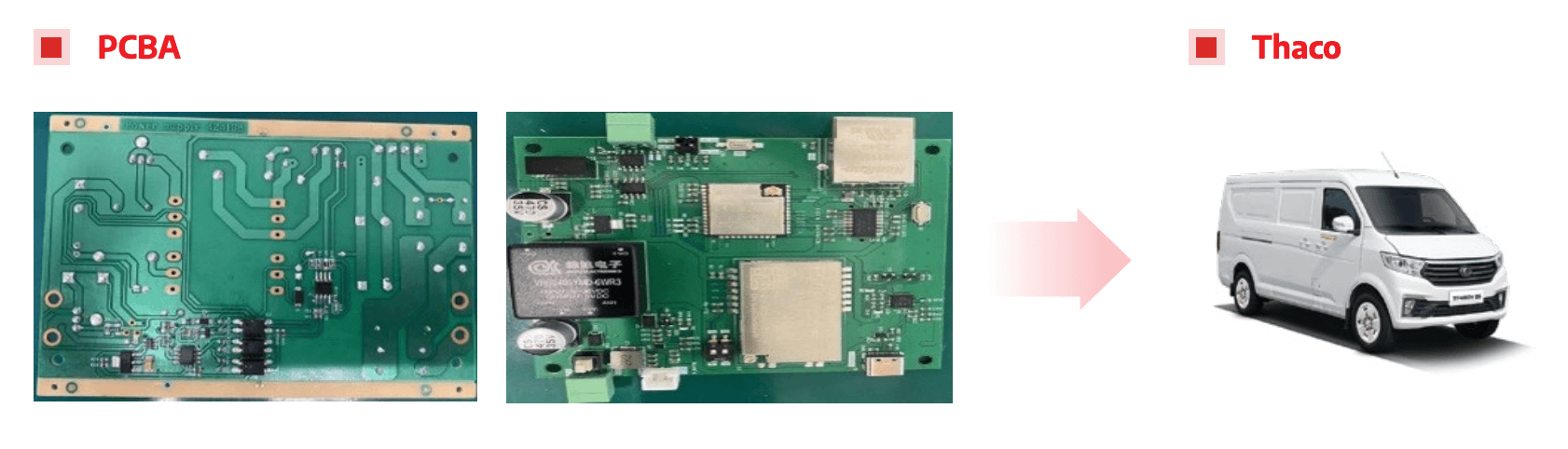
Thaco Automotive PCBA: Produced under PPAP-level documentation standards for one of Vietnam’s largest automotive groups — requiring full component traceability, Control Plan compliance, and 8D-capable quality records
GaN Power Electronics: High-density GaN fast chargers (65W to 150W, multi-port configurations) requiring precise process control documentation for global market compliance
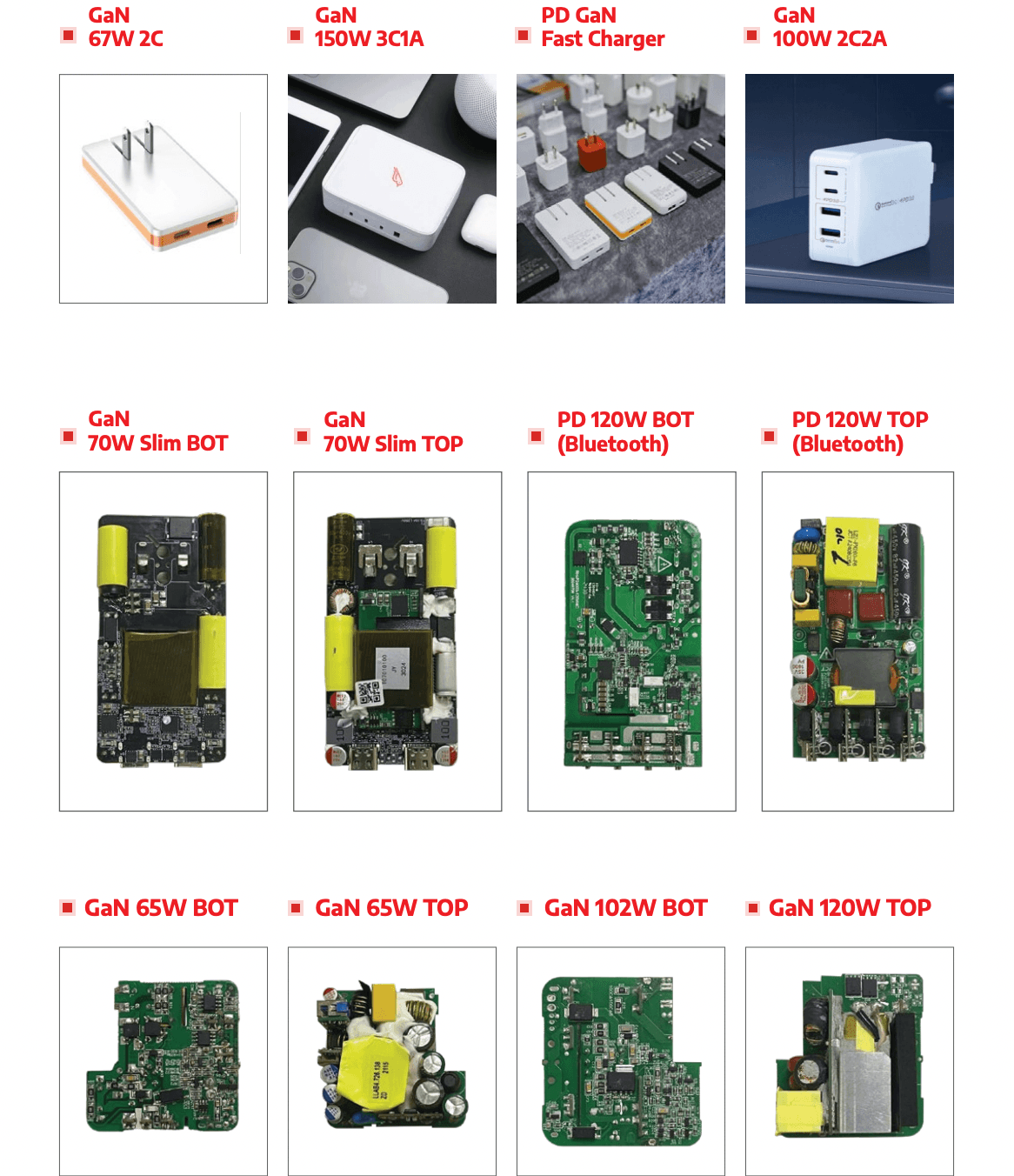
Industrial and Commercial Electronics: PCBA for PECO, Karofi/Tecomen water purifiers, and computer peripherals — all requiring documented production histories for warranty and quality management
SHDC is currently certified to ISO 9001 quality management standards, with quality processes aligned to the requirements of medical and automotive customers. (See SHDC’s full certification and quality standards.)
Phase 2 Expansion — March 2027: SHDC’s new facility at Lai Cach Industrial Park will add 10 SMT lines, 8 DIP lines, 10 assembly lines, and full inline ICT/FCT/AOI 3D capability — scaling traceability infrastructure to support 50M units/year production volume.

For OEMs evaluating Vietnam as a manufacturing base, see why SHDC is a trusted non-China PCBA manufacturer and industrial electronics manufacturing in Vietnam.
Frequently Asked Questions
What is traceability in electronics manufacturing?
Traceability in electronics manufacturing is the ability to reconstruct the complete production history of any individual PCB or electronic assembly — including every component used, every process step performed, every operator involved, and every test result recorded — using a unique identifier such as a board serial number or barcode.
Why is traceability required for medical devices?
Medical device traceability is mandated by EU MDR Article 27 (UDI system), FDA 21 CFR Part 820.65 (Device History Records), and ISO 13485:2016 Section 7.5.9. These regulations require that any field failure or nonconformance can be investigated with full production data — and that affected products can be identified and recalled with precision.
What is component-level traceability in PCB assembly?
Component-level traceability means that every individual component placed on a PCB is recorded with its specific reel ID, supplier lot number, placement position, placement machine, and timestamp — all linked to the board’s unique serial number. This enables investigators to identify exactly which boards contain a specific component lot in the event of a supplier quality issue.
What standards require traceability in electronics manufacturing?
Key standards include: ISO 13485:2016 (medical devices), EU MDR 2017/745 (EU medical market), FDA 21 CFR Part 820 (US medical market), IATF 16949 (automotive), IPC-A-610 Class 3 (high-reliability electronics), and IPC-7711/7721 (rework and repair).
How does MES support traceability in EMS?
A Manufacturing Execution System (MES) captures production data in real time — machine parameters, operator actions, inspection results, and test data — and links all records to individual board serial numbers. Without MES integration, traceability relies on manual records that are slow to retrieve, prone to gaps, and difficult to audit.
What should I ask an EMS partner about their traceability system?
Ask:
(1) Is traceability data captured in real time via MES, or reconstructed from paper records?
(2) Can you retrieve the full production history of a specific board serial number in under 10 minutes?
(3) How long is traceability data retained?
(4) Can you generate an affected serial number list from a component lot ID?
(5) Have you conducted a mock recall drill?
How long should traceability records be retained for medical devices?
EU MDR requires technical documentation to be retained for a minimum of 10 years after the last device was placed on the market (15 years for implantable devices). FDA 21 CFR Part 820 requires Device History Records to be retained for the expected life of the device or 2 years from release date, whichever is longer — though most medical OEMs specify 10+ years in their supplier contracts.
Conclusion: Traceability Is Risk Infrastructure, Not a Feature
The regulatory trajectory for medical and industrial electronics is clear: traceability requirements are increasing in scope, specificity, and enforcement. EU MDR continued to demand exhaustive documentation and lifecycle traceability in 2026, with no indication of relaxation ahead.
For OEMs, the practical implication is straightforward: an EMS partner without robust digital traceability is a liability in your supply chain — not because of what they’re doing wrong today, but because of what you won’t be able to prove when something goes wrong tomorrow.
The right EMS partner doesn’t just have a traceability system — they can demonstrate it, audit it, and use it to protect your products and your customers.
If your products require full component-level traceability — whether for medical, industrial, or automotive applications — SHDC’s integrated AIT Tracer and MES infrastructure is built to meet that requirement from day one.
👉 Get a PCB Assembly Quote — share your BOM and requirements, and our engineering team will respond within 24 hours.
👉 Talk to Our Engineering Team — discuss your traceability requirements directly with SHDC’s quality and production specialists.
Read more: Electronics Factory Audit Checklist for U.S. OEMs Sourcing in Vietnam
