Tiếng Việt
 日本語
日本語
Finding an electronics manufacturing supplier is relatively easy. Qualifying the right supplier is much harder. For U.S. OEMs, choosing an electronics supplier based only on price, production capacity, or a list of certifications can create significant risks later—from inconsistent PCBA quality and production delays to weak traceability and poor engineering support. A proper electronics supplier qualification process evaluates whether a manufacturer can consistently meet your technical, quality, production, compliance, delivery, and commercial requirements. This guide explains the key steps U.S. OEMs should follow when qualifying an electronics manufacturing partner, particularly for PCB assembly, PCBA, SMT, box build, and contract electronics manufacturing programs.
What Is Electronics Supplier Qualification?
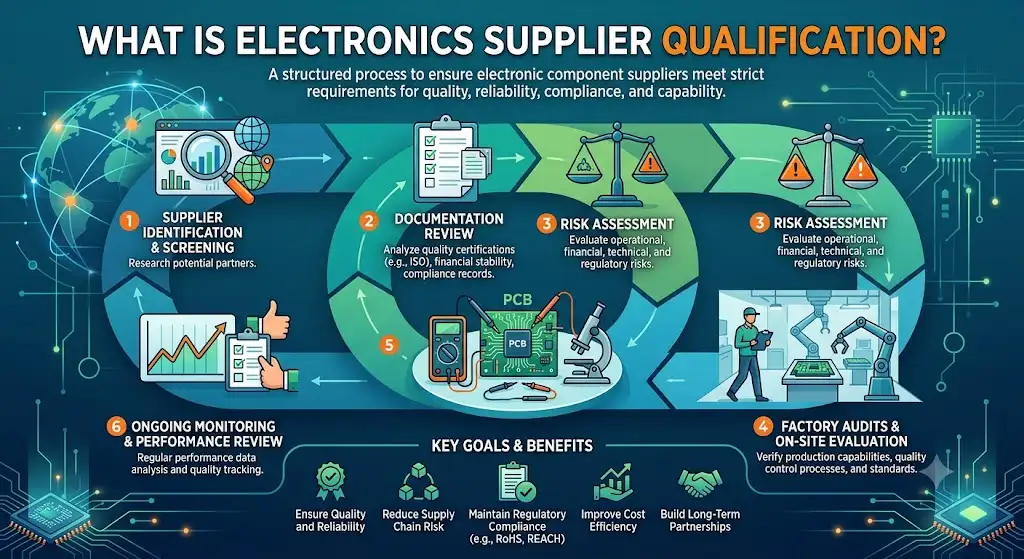
Electronics supplier qualification is the structured process of evaluating and approving a supplier before allowing it to manufacture or supply products for an OEM.
The assessment typically covers six major areas:
- Manufacturing capabilities
- Quality management
- Engineering and NPI support
- Compliance and certifications
- Capacity and supply-chain reliability
- Commercial and communication performance
The goal is not simply to determine whether a supplier can build your product once. The real question is whether the supplier can consistently build it to specification, at the required volume and quality level, over the entire production lifecycle.
Supplier Qualification vs. Supplier Selection
These terms are related but not identical.
Supplier selection focuses on identifying the most suitable candidates from a group of potential manufacturers.
Supplier qualification goes deeper by verifying whether a shortlisted supplier actually meets your requirements through documentation reviews, capability assessments, factory audits, sample builds, testing, and pilot production.
Supplier approval is the final decision to authorize the supplier for production or a specific product program.
For U.S. OEMs, treating these as separate stages creates a more disciplined sourcing process.
Why Electronics Supplier Qualification Matters for U.S. OEMs
A supplier may offer an attractive quotation while still creating significant downstream costs.
For example, a low initial price can become less attractive if the manufacturer has:
- High defect rates
- Poor first-pass yield
- Long or inconsistent lead times
- Weak engineering support
- Limited testing capability
- Poor material control
- Inadequate traceability
- Slow corrective-action response
- Limited production scalability
This is why supplier qualification should evaluate total manufacturing risk, rather than simply the quoted unit price.
For U.S. companies diversifying production to Vietnam or other offshore locations, supplier qualification is especially important because geographical distance makes it more difficult to resolve problems through frequent on-site interaction.
A structured electronics factory audit checklist can help procurement and engineering teams evaluate manufacturing infrastructure, quality controls, production processes, and factory management more systematically.
Electronics Supplier Qualification Process: 8 Key Steps
A practical qualification process can be divided into eight stages.
Step 1: Define Your Supplier Qualification Requirements
Before contacting suppliers, establish what your manufacturing partner must be capable of delivering.
Your requirements should cover:
- Product type and application
- PCB and PCBA complexity
- Component technologies
- Expected annual production volume
- Prototype requirements
- Target production cost
- Quality requirements
- Testing requirements
- Required certifications
- Traceability requirements
- Lead-time expectations
- Packaging requirements
- Engineering support
- Expected production ramp
For example, a supplier for a simple consumer electronics board may not require the same capabilities as a supplier producing an industrial controller or automotive electronic assembly.
The more clearly these requirements are defined, the easier it becomes to compare suppliers objectively.
Step 2: Pre-Qualify Potential Electronics Suppliers

Once requirements are defined, create an initial supplier shortlist.
At this stage, look beyond marketing claims and evaluate objective information such as:
- Manufacturing capabilities
- Factory location
- Industry experience
- Product categories served
- Production equipment
- Engineering resources
- Quality certifications
- Testing capabilities
- Export experience
- Production capacity
- Customer profile
A useful pre-qualification question is:
Does this supplier have the infrastructure and experience required for my specific product—not simply electronics manufacturing in general?
For example, an EMS provider may have strong SMT capabilities but limited box-build assembly or functional testing. Another supplier may have high-volume production experience but lack the engineering resources needed for NPI.
U.S. OEMs can also use electronics supplier due diligence to investigate supplier stability, business practices, capabilities, and potential risks before moving to a full qualification process.
Step 3: Evaluate Manufacturing Capabilities
Manufacturing capability should be evaluated against the actual requirements of your product.
For PCBA and electronics manufacturing programs, review areas such as:
SMT capabilities
Check:
- Component size capability
- Placement accuracy
- SMT line configuration
- SPI
- AOI
- Reflow process control
- Production capacity
Understanding the supplier’s actual SMT process is more useful than simply asking whether it has “SMT capability.” SHDC’s SMT assembly process guide provides additional context on how an OEM can evaluate the process.
THT/DIP capabilities
For products using through-hole components, verify:
- THT component insertion
- Manual or automated processes
- Wave or selective soldering
- Inspection
- Rework capability
Testing capabilities
Testing should be matched to product requirements.
Potential capabilities include:
- SPI
- AOI
- ICT
- FCT
- Electrical testing
- Functional testing
- Aging or burn-in where applicable
Do not assume that a supplier offering PCB assembly automatically has the testing infrastructure required for your product.
Final assembly
For products requiring more than PCBA, evaluate:
- Box build
- Cable assembly
- Wire harness
- Mechanical integration
- Labeling
- Packaging
- Final inspection
This distinction is particularly important when deciding between a PCB assembly supplier and a full-service EMS partner. SHDC’s full turnkey electronics manufacturing model provides a useful reference for evaluating the broader scope of manufacturing services.
Step 4: Evaluate the Supplier’s Quality System
A supplier qualification process should never stop at:
“Do you have ISO certification?”
Certification is useful, but U.S. OEMs should also evaluate how the supplier actually controls production.
Review:
- Incoming quality control
- Process quality control
- Final inspection
- SPI and AOI
- ICT/FCT
- Non-conforming material control
- Corrective and preventive actions
- Calibration
- Process documentation
- Operator training
- Traceability
- Quality data collection
Check Site-Specific Certifications
Always confirm that the certification applies to the specific manufacturing facility producing your product.
This matters when a supplier operates multiple factories, subcontractors, or production locations.
The relevant standard also depends on the application. A general electronics program may have different quality requirements from an automotive or medical electronics program.
Step 5: Review Engineering and NPI Capabilities
A strong electronics supplier should do more than follow manufacturing instructions.
For OEMs developing new products, engineering collaboration can have a significant impact on manufacturing cost, yield, and production stability.
Ask whether the supplier can support:
- DFM review
- DFT review
- BOM analysis
- Component risk identification
- PCB assembly feasibility
- Prototype builds
- Pilot production
- Process optimization
- Engineering change management
- Production readiness
For example, a supplier that identifies a component placement problem before production can potentially prevent defects and rework later.
For deeper technical evaluation, review SHDC’s DFM guide for electronics OEMs and DFT guide for electronics OEMs.
NPI capability should also be evaluated separately from mass-production capacity. SHDC’s NPI in Electronics Manufacturing guide covers the transition from prototype development toward scalable production.
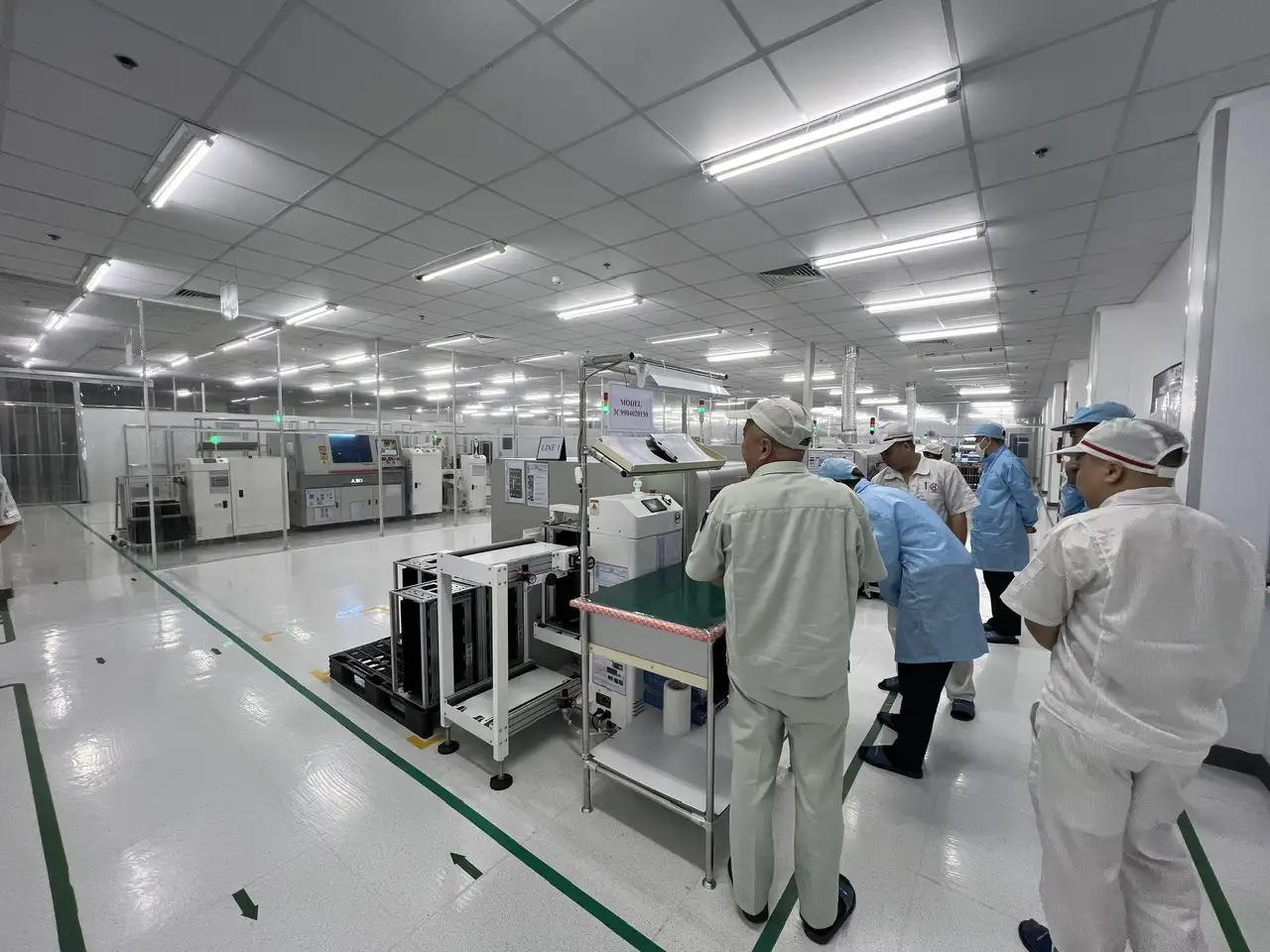
Step 6: Conduct a Supplier Factory Audit
For high-value or long-term manufacturing programs, documentation alone is rarely enough.
A factory audit allows the OEM to verify whether the supplier’s actual operations match its claims.
What Should U.S. OEMs Audit?
1. Manufacturing
Inspect:
- SMT lines
- THT/DIP processes
- Assembly areas
- Testing stations
- Rework areas
- Material flow
2. Quality
Check:
- Inspection equipment
- Calibration records
- Quality documentation
- Defect management
- Non-conforming material controls
- Corrective-action procedures
3. Materials
Evaluate:
- Component storage
- ESD controls
- Moisture-sensitive component handling
- Inventory management
- Material identification
- FIFO controls where applicable
4. Production management
Review:
- Work instructions
- Production records
- MES/ERP systems
- Traceability
- Production scheduling
- Change management
A supplier factory audit should focus not only on what equipment is present, but also on whether the processes are controlled and repeatable.
Step 7: Validate With Samples and Pilot Production
One of the most common supplier qualification mistakes is approving a supplier based entirely on: documents + certifications + factory visit.
A supplier should ultimately demonstrate its capability through production.
Prototype or Sample Evaluation
Evaluate:
- Assembly quality
- Component placement
- Solder quality
- Workmanship
- Functional performance
- Test results
- Documentation accuracy
For development-stage products, prototype PCBA can also reveal whether the supplier provides useful manufacturing feedback before production scales.
SHDC’s Prototype PCBA Manufacturing resource provides additional context on moving from concept to a first working board.
Pilot Production
A pilot run provides stronger evidence of process stability.
Evaluate:
- Yield
- Defect rate
- First-pass yield
- Process consistency
- Test coverage
- Cycle time
- Rework rate
- Repeatability
The objective is to determine whether the supplier can move from “we can build it” to “we can build it consistently.”
Step 8: Approve and Continuously Monitor the Supplier
Supplier qualification should not end when the supplier is approved.
Once production begins, OEMs should continue monitoring performance using measurable KPIs.
| Evaluation area | Example metrics |
|---|---|
| Quality | Defect rate, PPM, FPY, yield |
| Delivery | On-time delivery, lead-time consistency |
| Engineering | DFM/NPI support, response time |
| Capacity | Available capacity, scalability |
| Compliance | Certification and documentation status |
| Cost | Cost stability, variance |
| Service | Communication and issue resolution |
A supplier that performed well during qualification can still experience changes in capacity, management, material sources, or production conditions.
Continuous supplier performance monitoring helps identify these issues before they become major production problems.
Electronics Supplier Qualification Checklist for U.S. OEMs
Before approving an electronics supplier, procurement and engineering teams should verify the following.
Technical
- Required PCB/PCBA capabilities
- SMT and THT capability
- Required component size capability
- Testing capability
- DFM/DFT support
- Prototype and NPI capability
Quality
- Relevant certifications
- Documented quality system
- Inspection equipment
- Calibration process
- CAPA process
- Traceability system
Manufacturing
- Current production capacity
- Scalability
- Equipment condition
- Material management
- Production controls
- Backup or contingency planning
Commercial
- Competitive total cost
- MOQ
- Lead time
- Payment terms
- Export experience
- Logistics capabilities
Supplier stability
- Factory verification
- Customer references where available
- Business continuity planning
- Supply-chain risk management
- Communication and escalation process
How to Score and Compare Electronics Suppliers
When multiple suppliers pass the initial qualification stage, a weighted scoring system can make the final decision more objective.
A practical starting point might look like this:
| Category | Suggested weight |
|---|---|
| Quality | 25% |
| Manufacturing capability | 20% |
| Engineering & NPI | 15% |
| Delivery & capacity | 15% |
| Compliance | 10% |
| Cost | 10% |
| Communication & support | 5% |
These weights are not universal. A medical or automotive program, for example, may place substantially more emphasis on quality, traceability, validation, and compliance.
The key principle is:
Do not let price dominate the supplier qualification score.
A supplier with a slightly lower quotation but weaker yield, poor delivery performance, or inadequate engineering support can have a higher total cost over the life of the program.
Red Flags When Qualifying an Electronics Supplier
U.S. OEMs should be cautious when a potential supplier:
- Cannot provide site-specific certifications.
- Makes capability claims that are not supported by equipment or process evidence.
- Has no clear traceability system.
- Cannot explain how quality problems are investigated and corrected.
- Has no documented NPI or production transfer process.
- Provides unclear information about available capacity.
- Relies heavily on subcontracting without transparent controls.
- Focuses almost entirely on low pricing.
- Has weak engineering communication.
- Shows significant differences between sales claims and factory audit findings.
One red flag alone may not disqualify a supplier. However, several together should trigger a deeper investigation.
Electronics Supplier Qualification for Vietnam Manufacturing
Vietnam can be an attractive manufacturing location for U.S. OEMs, but location alone should never be the reason to approve a supplier.
When evaluating a Vietnam-based electronics manufacturer, U.S. buyers should assess the same fundamentals they would use anywhere else:
- Manufacturing capability
- Quality systems
- Engineering resources
- Production capacity
- Component sourcing
- Testing
- Traceability
- Export experience
- Supply-chain resilience
- Communication
- Scalability
This is particularly relevant for companies pursuing a China+1 strategy. Supplier qualification should verify whether the Vietnam facility can support the specific product and production requirements rather than assuming that geographic diversification automatically reduces risk.
For broader context, see SHDC’s Electronics Supply Chain Diversification guide and Contract Electronics Manufacturing in Vietnam.
How SHDC Supports Electronics Supplier Qualification

For OEMs evaluating SHDC as a potential manufacturing partner, qualification should be based on verifiable manufacturing capabilities rather than marketing claims.
SHDC’s manufacturing scope covers areas relevant to electronics production programs, including SMT/PCBA assembly, testing, engineering support, and production management. Its existing manufacturing resources also cover DFM, DFT, NPI, production readiness, and PCBA RFQ requirements.
For U.S. OEMs, this means the qualification discussion can move beyond a basic supplier questionnaire and into specific questions about:
- Product requirements
- PCB/PCBA complexity
- Component sourcing
- DFM/DFT
- Prototype and NPI
- Testing requirements
- Production volume
- Quality expectations
- Traceability
- Production readiness
- RFQ documentation
SHDC also provides a PCBA Manufacturer Vietnam RFQ Checklist for U.S. OEMs that can help buyers prepare the information manufacturers need before quoting a project.
The right approach is to treat SHDC—or any potential supplier—as a candidate that should be evaluated against the OEM’s documented requirements.
Final Takeaway: Qualify Suppliers Before You Commit Production
The best electronics supplier is not necessarily the manufacturer offering the lowest initial quote.
For U.S. OEMs, a reliable qualification process should evaluate manufacturing capability, quality, engineering support, testing, traceability, capacity, compliance, delivery performance, and long-term supply-chain reliability.
A strong process typically follows this sequence:
Define requirements → Pre-qualify suppliers → Evaluate capabilities → Audit the factory → Validate samples → Run pilot production → Score and approve → Monitor performance
This approach gives procurement, engineering, and quality teams a shared framework for making supplier decisions based on evidence rather than assumptions.
For OEMs sourcing electronics manufacturing in Vietnam, the same principle applies: qualify the supplier first, then negotiate the production program.
Frequently Asked Questions
What is electronics supplier qualification?
Electronics supplier qualification is the process of evaluating and approving a manufacturer based on its technical capabilities, quality system, engineering resources, production capacity, compliance, delivery performance, and commercial suitability.
What are the main steps in supplier qualification?
The main steps include defining requirements, pre-qualifying suppliers, evaluating manufacturing capabilities, reviewing quality systems, conducting factory audits, validating samples or pilot production, approving the supplier, and continuously monitoring performance.
What should U.S. OEMs look for in an electronics supplier?
U.S. OEMs should evaluate manufacturing capabilities, quality controls, testing, engineering and NPI support, traceability, production capacity, certifications, delivery performance, communication, and supply-chain risk.
What certifications should an electronics manufacturer have?
The appropriate certifications depend on the product and industry. ISO 9001 may be relevant for general quality management, while industries such as automotive or medical devices can have additional sector-specific requirements. OEMs should verify that certifications apply to the actual manufacturing site.
How do you audit an electronics manufacturing supplier?
A supplier audit should examine manufacturing processes, SMT/THT capabilities, testing, material handling, quality controls, traceability, production records, equipment, calibration, operator training, and corrective-action systems.
What is the difference between supplier qualification and supplier selection?
Supplier selection identifies the most suitable candidates. Supplier qualification verifies that a shortlisted supplier actually meets the required technical, quality, manufacturing, and commercial criteria before approval.