Tiếng Việt
 日本語
日本語
Choosing a PCBA manufacturing partner is not only about finding the lowest unit price. For US OEMs, the quality of the RFQ package directly affects quotation accuracy, component sourcing risk, engineering review time, production lead time, and long-term manufacturability. If you are evaluating a PCBA manufacturer Vietnam, this RFQ checklist will help you prepare the right technical, commercial, and quality information before requesting a quote. A complete RFQ allows the manufacturer to understand your design, estimate production cost accurately, identify risks early, and recommend improvements before the project enters prototype, pilot run, or mass production.
Why US OEMs Need a Clear PCBA RFQ
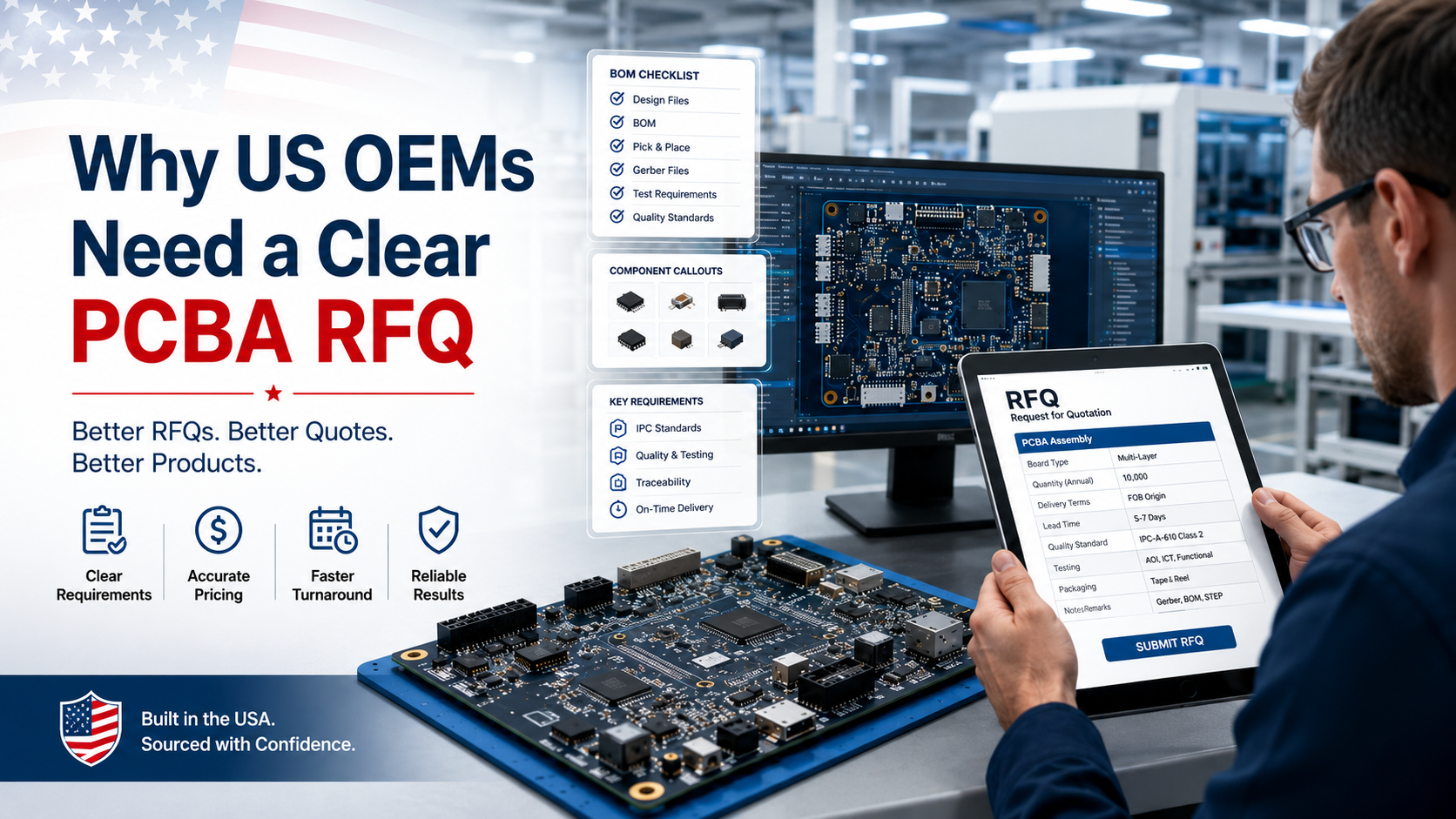
A PCBA RFQ is more than a request for pricing. It is the technical foundation for manufacturing communication between the OEM and the EMS partner.
When an RFQ is incomplete, the manufacturer must make assumptions. Those assumptions may affect component pricing, SMT setup, test coverage, lead time, packaging cost, and even the final quality of the assembled board.
A complete RFQ helps US OEMs achieve three important goals.
First, it improves quotation accuracy. A manufacturer can only provide a reliable pcb assembly quote when it has enough data to calculate PCB fabrication, component sourcing, SMT placement, through-hole assembly, inspection, testing, labor, tooling, packaging, and logistics.
Second, it reduces engineering clarification loops. Missing files such as BOM, pick-and-place data, assembly drawings, and test requirements often delay the quotation process.
Third, it helps OEMs compare suppliers fairly. If every PCBA manufacturer receives the same RFQ package, the OEM can evaluate pricing, lead time, quality process, and engineering feedback on a consistent basis.
PCBA RFQ Checklist: Key Files to Prepare
Before sending your RFQ to a PCBA manufacturer in Vietnam, prepare a complete technical package. At minimum, your RFQ should include PCB fabrication files, BOM, pick-and-place data, assembly drawings, testing requirements, target quantity, and commercial expectations.
| RFQ Item | Required? | Why It Matters |
|---|---|---|
| Gerber or ODB++ files | Yes | Defines PCB layers, solder mask, drill data, and board outline |
| BOM | Yes | Enables component pricing, sourcing review, and lifecycle checks |
| Pick-and-place file | Yes | Guides SMT placement position, rotation, and side |
| Assembly drawing | Recommended | Reduces assembly errors and clarifies polarity/orientation |
| PCB fabrication drawing | Recommended | Defines board thickness, stack-up, copper weight, finish, and tolerances |
| Test plan | Recommended | Helps quote ICT, FCT, programming, fixtures, and inspection |
| Production quantity | Yes | Affects pricing, MOQ, setup cost, and lead time |
| Quality requirements | Yes | Defines inspection level, acceptance criteria, and traceability needs |
| Packaging requirements | Optional | Impacts ESD protection, carton labels, barcodes, and logistics |
| Shipping destination | Yes | Helps estimate export, freight, and delivery terms |
1. Gerber Files or ODB++ Data
Gerber files are the core manufacturing files for PCB fabrication. They describe the physical layers of the bare PCB and allow the fabricator to build the board according to the design intent.
A complete Gerber package should include:
- Copper layers
- Solder mask layers
- Silkscreen layers
- Paste layers
- Drill files
- Board outline
- NC drill data
- Mechanical layers if applicable
For more complex boards, ODB++ may provide a more complete manufacturing dataset because it can include layer structure, netlist information, drill data, and assembly-related details in one package.
Before sending the RFQ, verify that the file revision is current. One of the most common RFQ mistakes is sending a BOM from one design revision and Gerber files from another. That mismatch can cause wrong pricing, incorrect sourcing, or manufacturing delays.
Expert Tip: Always include a revision control table in your RFQ email or project folder. Clearly mark files as “Rev A,” “Rev B,” or “Production Release” so the manufacturer knows which version should be quoted.
2. Bill of Materials — BOM
The BOM is one of the most important documents in a PCBA RFQ. It determines component sourcing cost, availability, approved alternatives, and production risk.
A strong BOM should include:
- Reference designator
- Manufacturer part number
- Supplier part number if available
- Component description
- Quantity per board
- Package type
- Value or specification
- Approved manufacturer list
- Approved alternatives
- Do-not-populate parts
- Lifecycle status if known
- RoHS or compliance requirements if applicable
A weak BOM only includes values such as “10k resistor” or “capacitor 1uF.” That is not enough for accurate quoting. Component value alone does not define voltage rating, tolerance, package size, temperature rating, dielectric type, or approved supplier.
For US OEMs, BOM clarity is especially important because component substitution can affect compliance, reliability, and product performance. If alternatives are allowed, define which parts are approved. If substitutions require engineering approval, state that clearly in the RFQ.
3. Pick-and-Place File
The pick-and-place file, also called a centroid file, is required for SMT assembly. It tells the placement machine where each component should be placed on the board.
A proper pick-and-place file should include:
- Reference designator
- X and Y coordinates
- Rotation
- Board side
- Package footprint
- Component center point
Incorrect rotation data can cause serious assembly errors, especially for polarized components, connectors, ICs, LEDs, diodes, and modules. Before sending the RFQ, compare the pick-and-place file with the assembly drawing and PCB layout.
If the project includes double-sided SMT, make sure the file clearly separates top-side and bottom-side components.
4. Assembly Drawing
An assembly drawing helps the manufacturer understand placement orientation, polarity, mechanical constraints, and special assembly notes. Even when pick-and-place data is available, an assembly drawing provides a valuable visual reference.
Your assembly drawing should show:
- Component outlines
- Reference designators
- Polarity marks
- Connector orientation
- Pin 1 indicators
- Mounting hole locations
- Mechanical keep-out areas
- Special soldering instructions
- Notes for do-not-populate components
Assembly drawings are especially useful for boards with connectors, LEDs, switches, batteries, displays, cables, or mechanical enclosures.
5. PCB Fabrication Drawing
A PCB fabrication drawing defines the physical requirements of the bare board. It is especially important when your design has controlled impedance, special materials, tight tolerances, or mechanical constraints.
Include these details when relevant:
- Board dimensions
- Layer count
- PCB material
- Board thickness
- Copper thickness
- Surface finish
- Solder mask color
- Silkscreen color
- Minimum hole size
- Impedance requirements
- Stack-up
- Tolerance requirements
- Panelization preference
- Edge plating or slots if applicable
If your project has high-speed signals, RF sections, power electronics, or safety-related spacing requirements, the fabrication drawing should be reviewed carefully before quoting.
Component Sourcing Checklist
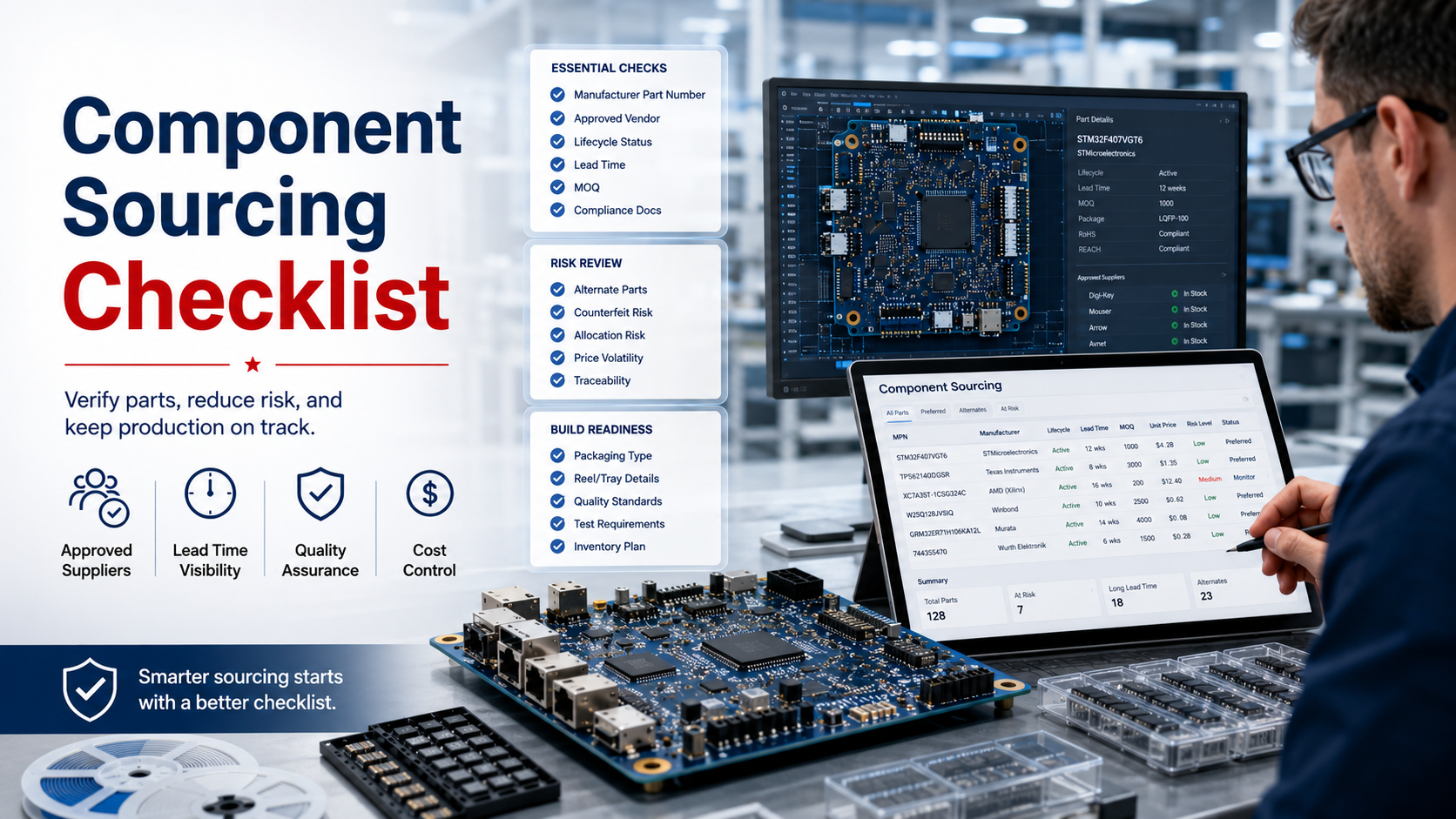
Component sourcing can be handled in different ways depending on the project. The RFQ should clearly define whether the PCBA manufacturer is responsible for all sourcing, partial sourcing, or assembly only.
Turnkey Sourcing
In a turnkey model, the manufacturer sources the PCB, components, and assembly materials. This is often preferred by OEMs that want a single manufacturing partner to manage the full supply chain.
Turnkey sourcing can reduce purchasing workload, but it requires a strong BOM and clear substitution rules.
Consigned Sourcing
In a consigned model, the OEM provides some or all components to the manufacturer. This model is useful when the OEM already owns inventory, uses restricted components, or wants direct control over critical parts.
If using consigned components, specify packaging format, moisture sensitivity level, quantity supplied, and whether excess parts are included for machine attrition.
Hybrid Sourcing
In a hybrid model, the OEM provides certain key components while the manufacturer sources standard passives, connectors, PCB, and other materials.
This model is common when some components are expensive, proprietary, long-lead, or customer-controlled.
Technical Requirements to Include in the RFQ
A good RFQ should not only ask for price. It should define how the board will be built, inspected, tested, and accepted.
SMT and Through-Hole Assembly Requirements
Clearly state the assembly type required:
- SMT assembly
- Through-hole assembly
- Mixed technology
- Double-sided SMT
- Hand soldering
- BGA or QFN assembly
- Fine-pitch IC placement
- Connector assembly
- Cable or wire attachment
- Mechanical assembly
If your board includes BGA, QFN, microcontrollers, large inductors, tall capacitors, press-fit connectors, or high-power components, highlight them in the RFQ. These parts may affect inspection method, stencil design, reflow profile, and assembly cost.
For projects involving both surface mount and through-hole processes, link the RFQ to the correct assembly flow and clarify whether wave soldering, selective soldering, or manual soldering is expected.
Testing and Inspection Requirements
Testing is one of the most commonly underdefined parts of a PCBA RFQ. If the OEM does not specify testing, the manufacturer may quote basic assembly only. That can make the initial price look lower, but it may not reflect the real production requirement.
Common PCBA inspection and testing methods include:
- Visual inspection
- Solder paste inspection
- automated Optical Inspection
- X-ray inspection for hidden solder joints
- in-circuit testing
- Flying probe testing
- Functional testing
- Firmware programming
- Burn-in or aging test
- High-voltage test if applicable
- Custom test fixture
If your product requires functional testing, provide a test procedure. The manufacturer needs to know input voltage, test points, expected output, firmware loading method, pass/fail criteria, required cables, software, fixtures, and test duration.
Common Mistake: Many OEMs request a PCBA quotation but forget to include the test plan. Later, when functional testing is added, the final cost changes because fixtures, programming, operator time, and test equipment were not included in the original quote.
Quality Standards and Acceptance Criteria
Quality requirements should be clearly defined before production. Do not assume every supplier will use the same acceptance level unless it is written into the RFQ.
Depending on the product and market, the RFQ may need to specify:
- IPC assembly class requirement
- Visual inspection criteria
- Solder joint acceptance criteria
- First article inspection
- Traceability requirement
- Lot control
- Serial number or barcode tracking
- Material compliance requirements
- Failure analysis process
- Required inspection reports
For PCB assembly acceptability, many OEMs refer to IPC-A-610 Standard as a common reference. The correct class should depend on product application, reliability expectations, and customer requirements.
If your project is used in medical, automotive, industrial, power electronics, or safety-related applications, define quality expectations early. A manufacturer cannot price inspection and documentation correctly without knowing the acceptance requirements.
Production Quantity, Lead Time, and Commercial Details

A PCBA manufacturer needs volume information to quote accurately. Setup time, stencil cost, fixture cost, component MOQ, SMT programming, and labor efficiency all depend on production quantity.
Include quantity breaks such as:
- Prototype quantity
- Engineering validation quantity
- Pilot run quantity
- First production order
- Annual forecast
- Expected repeat order volume
If you are comparing pcb assembly cost, ask suppliers to quote multiple quantity breaks. A board that is expensive at 50 pieces may become much more efficient at 500 or 5,000 pieces because setup costs are distributed across more units.
Lead time should also be defined clearly. Ask the manufacturer to separate:
- PCB fabrication lead time
- Component sourcing lead time
- SMT assembly lead time
- Testing lead time
- Packaging lead time
- Shipping lead time
Understanding pcb assembly lead time helps US OEMs plan launch schedules, production ramp-up, and inventory strategy.
DFM and DFT Review Before Quotation
A reliable manufacturer should not only quote the design but also review it for manufacturability and testability. This is especially important before pilot production or mass production.
DFM Review
Design for Manufacturing focuses on whether the board can be built efficiently and consistently. A practical DFM for electronics manufacturing review may include:
- Component spacing
- Pad design
- Solder mask clearance
- Fiducial placement
- Panelization
- Thermal relief
- Tall component placement
- Connector accessibility
- Reflow compatibility
- Wave soldering constraints
- Component orientation
- Board handling during assembly
A dfm checklist should be completed before production release, not after defects appear on the line.
DFT Review
Design for Testability focuses on whether the board can be tested efficiently. A good design for testability review may evaluate:
- Test point access
- Programming connector access
- Fixture contact areas
- Ground reference points
- Power rail test points
- Boundary scan options
- Functional test coverage
- Diagnostic visibility
DFT is often overlooked during early design, but it directly affects production yield, troubleshooting speed, and long-term quality control.
Supplier Evaluation for US OEMs
The RFQ process is also a supplier qualification process. US OEMs should evaluate not only the quote but also the manufacturer’s technical response.
A strong PCBA manufacturer should be able to identify missing files, ask relevant engineering questions, flag component risks, explain testing options, and provide realistic production assumptions.
When performing electronics supplier due diligence, consider these questions:
- Does the supplier ask detailed technical questions?
- Can they explain cost drivers clearly?
- Do they review BOM risk and component availability?
- Do they understand testing requirements?
- Can they support prototype, pilot, and production stages?
- Do they provide process transparency?
- Can they support communication across time zones?
- Do they have experience with export-oriented OEM projects?
The cheapest quote is not always the lowest-risk quote. A strong supplier may identify risks that a less experienced manufacturer overlooks.
Common RFQ Mistakes US OEMs Should Avoid
Sending an Incomplete BOM
If the BOM lacks manufacturer part numbers, package sizes, or reference designators, the manufacturer must guess or ask for clarification. This slows the quotation process and increases sourcing risk.
Not Defining Testing Requirements
Testing should not be treated as an afterthought. If ICT, FCT, programming, or burn-in is required, include that information in the first RFQ.
Ignoring Component Lead Time
Some components have long lead times, MOQ restrictions, or lifecycle risks. Ask the manufacturer to identify high-risk parts during the quotation stage.
Mixing File Revisions
Gerber, BOM, pick-and-place, and drawings must match the same revision. Revision mismatch is one of the fastest ways to create quotation errors.
Focusing Only on Unit Price
Unit price is important, but it should be evaluated together with NRE, tooling, testing, scrap assumptions, packaging, logistics, payment terms, and quality support.
Not Planning for Production Readiness
Before mass production, OEMs should complete a production readiness checklist covering engineering release, materials, equipment, test fixtures, packaging, documentation, and quality controls.
Sample RFQ Checklist for PCBA Manufacturing
Use the following checklist before sending your RFQ to a PCBA manufacturer in Vietnam.
| Category | Checklist Item | Status |
|---|---|---|
| Design files | Gerber or ODB++ files included | Required |
| Design files | PCB fabrication drawing included | Recommended |
| Assembly files | BOM with MPN and alternatives included | Required |
| Assembly files | Pick-and-place file included | Required |
| Assembly files | Assembly drawing included | Recommended |
| Components | Turnkey, consigned, or hybrid sourcing defined | Required |
| Components | Approved alternatives defined | Recommended |
| Components | Obsolete or long-lead components reviewed | Recommended |
| Manufacturing | SMT, DIP, or mixed assembly defined | Required |
| Manufacturing | BGA, QFN, fine-pitch, or special components highlighted | Recommended |
| Testing | AOI, ICT, FCT, programming, or burn-in defined | Required if applicable |
| Quality | IPC class or acceptance criteria defined | Recommended |
| Production | Prototype, pilot, and mass production quantity provided | Required |
| Commercial | Target lead time and delivery schedule included | Required |
| Packaging | ESD, barcode, carton label, or retail packaging defined | Optional |
| Logistics | Shipping destination and Incoterms preference included | Recommended |
How SHDC Supports PCBA RFQ Review and Manufacturing

For OEMs looking at Vietnam as an electronics manufacturing location, SHDC Electronics Co., Ltd. provides EMS capabilities covering component soldering, assembly, testing, and final packaging. The company profile also describes production capabilities across SMT, DIP, AI, backend welding, testing, assembly, packaging, electronic materials sourcing, and process improvement.
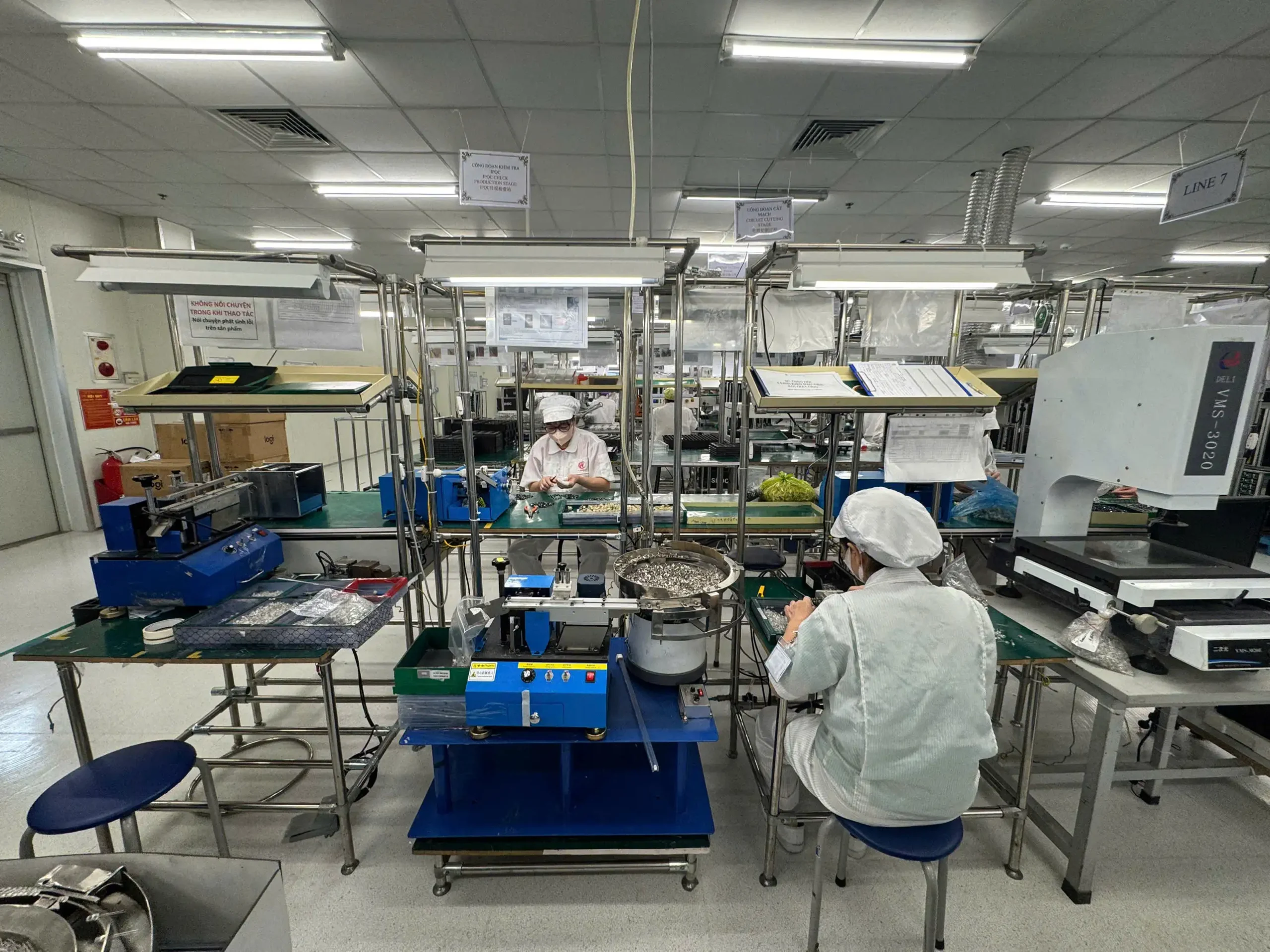
For current factory service scope, SHDC lists a production area of about 2,600 square meters, 150 employees, 4 high-speed SMT lines, 3 DIP lines, 1 assembly line, 1 test line, and 1 packaging line. Its process flow includes IQC inspection, warehouse, screen printing, mounting, reflow, AOI, component insertion, automatic soldering, ICT, FCT, visual inspection, OQC, packaging, and finished product warehouse.
The profile also lists production facilities such as Yamaha SMT equipment, 3D SPI, 3D AOI, ICT, wave soldering, reflow oven, component insertion equipment, high-voltage test, functional testing, aging test, and laser marking equipment.
For OEM projects that require broader manufacturing support, SHDC’s service model can also align with full turnkey electronics manufacturing, depending on the project scope, BOM readiness, sourcing model, testing requirements, and final assembly needs.
>>>Read more: SHDC – A Trusted Vietnam Electronics Manufacturing Company for Global Brands
From RFQ to Production: Recommended Workflow
A structured workflow helps reduce risk from quotation to production launch.
- Prepare the RFQ package: BOM, Gerber, pick-and-place, drawings, test plan, quantity, and quality requirements.
- Request DFM and BOM review before final pricing.
- Clarify component sourcing model and substitution rules.
- Confirm testing method, fixture needs, and pass/fail criteria.
- Review quotation assumptions, exclusions, and NRE costs.
- Build prototype or engineering validation samples.
- Review test results, yield issues, and engineering changes.
- Complete pilot production.
- Finalize production documentation.
- Move into controlled mass production.
If the project is still in early design transfer, an NPI electronics manufacturing process can help bridge the gap between engineering prototype and scalable production.
Any design change after quotation should be managed through a formal Engineering Change Orders (ECO) process to avoid confusion between engineering, purchasing, production, and quality teams.
Conclusion
A complete PCBA RFQ helps US OEMs receive faster, more accurate quotations and reduces the risk of design, sourcing, testing, and production issues later. When working with a PCBA manufacturer in Vietnam, the most important step is not simply asking for a price. It is providing the right technical and commercial information so the manufacturer can quote the project correctly and identify risks early.
Before sending your RFQ, prepare your Gerber files, BOM, pick-and-place file, drawings, test requirements, quality expectations, quantity forecast, and packaging or logistics requirements. The more complete your RFQ package is, the easier it becomes to compare suppliers, control cost, and move from prototype to production with fewer surprises.
For OEMs evaluating Electronics Manufacturing Vietnam or EMS Vietnam, a structured RFQ checklist is the best starting point for supplier communication, engineering review, and production planning.
CTA: Send your Gerber files, BOM, assembly drawings, and production requirements to SHDC for a PCBA manufacturing quotation review in Vietnam.
FAQs
What should be included in a PCBA manufacturing RFQ?
A PCBA manufacturing RFQ should include Gerber or ODB++ files, BOM, pick-and-place file, assembly drawing, PCB fabrication drawing, test requirements, quantity, lead time expectations, quality standards, packaging requirements, and shipping destination.
Why is the BOM important for a PCBA quotation?
The BOM determines component pricing, sourcing availability, approved alternatives, lifecycle risk, and production cost. Without a clear BOM, the manufacturer cannot quote accurately.
Do I need a test plan before requesting a PCBA quote?
A test plan is strongly recommended if the board requires functional testing, programming, ICT, burn-in, or custom fixtures. Without a test plan, the initial quote may exclude important testing costs.
What is the difference between DFM and DFT in PCBA manufacturing?
DFM focuses on whether the board can be manufactured efficiently and consistently. DFT focuses on whether the board can be tested effectively during production.
Why do US OEMs consider PCBA manufacturers in Vietnam?
US OEMs often consider Vietnam for electronics manufacturing as part of supply chain diversification, cost control, and offshore production planning. The right partner should be evaluated based on engineering support, process capability, quality control, communication, and production scalability.
How can OEMs compare PCBA quotes fairly?
To compare quotes fairly, send the same RFQ package to each supplier and review not only unit price but also tooling, NRE, testing, lead time, BOM assumptions, quality requirements, packaging, logistics, and exclusions.