Tiếng Việt
 日本語
日本語
This guide explains what OEMs should know before sourcing from China, when a China PCB manufacturer may still be the right choice, and when companies should consider Vietnam as an alternative for PCB assembly, PCBA manufacturing, and long-term EMS support.
Why OEMs Search for a China PCB Manufacturer
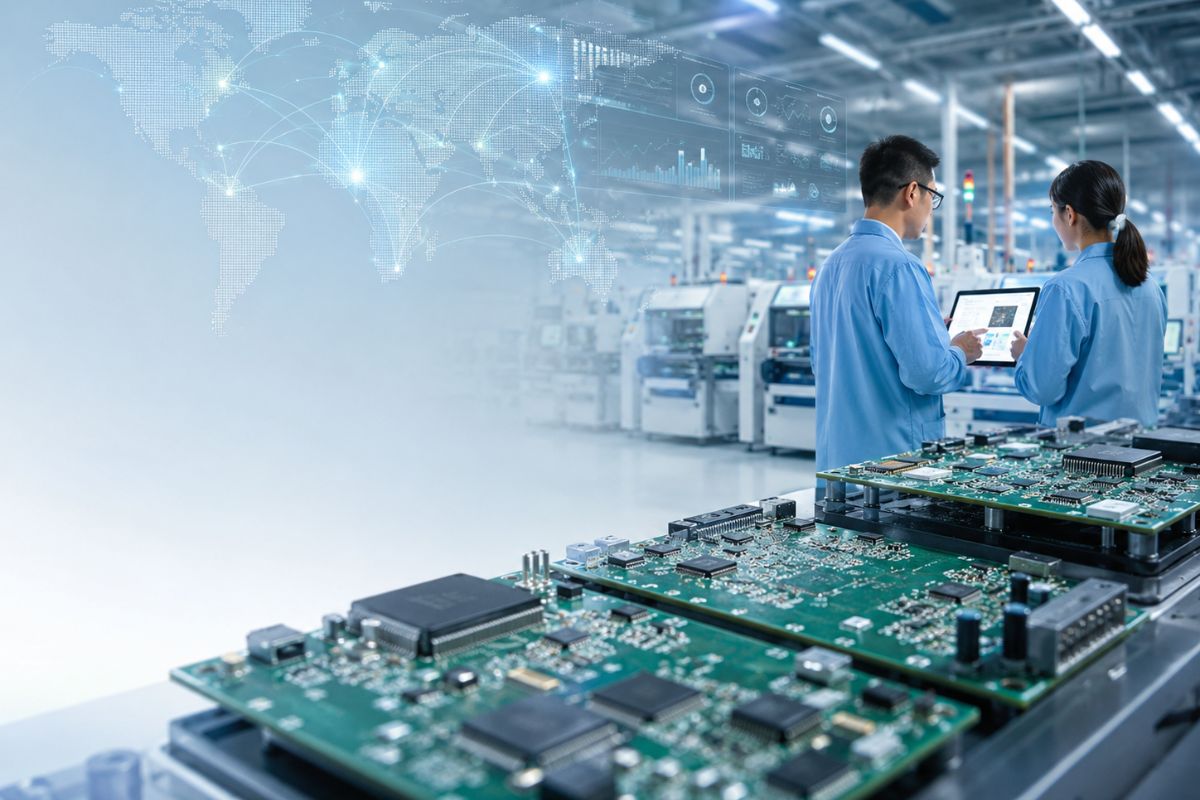
OEMs often search for a China PCB manufacturer because China has one of the most developed electronics manufacturing ecosystems in the world. From bare PCB fabrication to component sourcing, SMT assembly, mechanical parts, cables, packaging, and logistics, many supplier categories are available within a concentrated industrial network.
A China PCB manufacturer may be attractive when an OEM needs:
- PCB fabrication across different board types
- Fast prototype support
- Access to broad component sourcing channels
- SMT and through-hole assembly options
- Custom mechanical or enclosure support
- Supplier clusters for cables, plastics, metal parts, and packaging
- Rapid engineering changes during NPI
For early-stage product development, this ecosystem can be useful. A project with frequent BOM changes, uncertain mechanical design, or rapid prototype cycles may benefit from being close to a deep supplier network.
What Services Does a China PCB Manufacturer Usually Offer?
PCB Fabrication
A China PCB manufacturer may offer different types of bare board fabrication depending on factory capability. Common PCB fabrication services include single-layer PCBs, double-sided PCBs, multilayer PCBs, rigid PCBs, flexible PCBs, rigid-flex PCBs, HDI boards, controlled impedance boards, and different surface finish options.
PCB fabrication cost depends on board size, layer count, material, thickness, copper weight, surface finish, drill size, tolerance, minimum trace and spacing, and special requirements such as controlled impedance or blind and buried vias.
OEMs comparing China with other manufacturing locations should understand the difference between PCB fabrication and downstream assembly. For a detailed process view, buyers can also review the PCB manufacturing process and compare it with assembly requirements.
PCBA Assembly
Many China PCB manufacturers also provide PCBA assembly or work with assembly partners. PCBA assembly may include SMT assembly, DIP or through-hole assembly, mixed technology assembly, BGA placement, QFN and QFP assembly, inspection, testing, firmware programming, and packaging.
The assembly scope should be clarified before quotation. A supplier may quote only bare PCB fabrication, only assembly labor, or a complete PCB assembly package. For OEMs evaluating full assembly support, it is important to compare the China quote against PCB assembly cost categories such as BOM sourcing, SMT placement, DIP labor, test fixture, functional testing, packaging, and shipping.
Turnkey Manufacturing
Some suppliers provide turnkey manufacturing, meaning they manage PCB fabrication, component sourcing, assembly, testing, and packaging. This model can reduce supplier coordination work for the OEM, but it also requires stronger BOM control, approved vendor lists, substitution rules, and quality documentation.
When comparing turnkey suppliers, OEMs should ask whether the quote includes PCB fabrication, BOM procurement, SMT assembly, DIP assembly, AOI, ICT, FCT, firmware loading, packaging, and export documentation. If Vietnam is being considered as a second production base, OEMs can compare this with full turnkey electronics manufacturing options in Vietnam.
Key Advantages of Working With a China PCB Manufacturer
Mature Electronics Supply Chain
The biggest advantage of a China PCB manufacturer is access to a mature electronics supply chain. China has a broad supplier base for PCBs, electronic components, connectors, cables, enclosures, tooling, labels, cartons, and accessories.
This can be useful when a product requires fast sourcing from multiple categories. For example, a consumer electronics device may require PCB fabrication, PCBA assembly, plastic housing, cables, chargers, retail packaging, and accessory kits. In such cases, China’s supplier ecosystem may help reduce sourcing friction.
Fast Sourcing for Complex BOMs
China can be strong when the BOM includes hard-to-source ICs, custom connectors, modules, displays, sensors, or mechanical parts. The local supply chain may provide more sourcing options, especially during prototype and early NPI stages.
However, OEMs should still require clear sourcing rules. Component substitutions should not be allowed without written approval, especially for ICs, power components, connectors, safety-related parts, and components that affect firmware, thermal behavior, or compliance.
Prototype and NPI Ecosystem
For early product development, a China PCB manufacturer may support quick prototype iteration. Suppliers can often coordinate bare boards, components, assembly, and basic testing in a short timeline if the BOM is available.
For products still in design validation, China may remain a practical choice. But once the design becomes stable, many OEMs begin evaluating China alternative electronics manufacturing to reduce long-term supply chain dependency.
Risks OEMs Should Consider Before Choosing a China PCB Manufacturer
Tariff and Import Duty Exposure
For US OEMs, tariff exposure can significantly affect the real cost of choosing a China PCB manufacturer. Buyers should review official China Section 301 tariff actions, product HS codes, and applicable duty treatment before making sourcing decisions.
It is not enough to compare factory unit price. A lower ex-factory price may not result in lower landed cost after freight, customs clearance, duties, and compliance documentation are included.
Country-of-Origin Review
Country of origin can be complex when components are sourced from one country and final assembly happens in another. OEMs should understand how rules such as substantial transformation may apply to their product.
This is especially important when comparing China and Vietnam. Moving part of production outside China does not automatically determine origin treatment. The result depends on the product, manufacturing steps, BOM structure, and applicable customs rules.
Supply Chain Concentration Risk
Relying only on a China PCB manufacturer may create single-country dependency. If all PCB fabrication, PCBA assembly, sourcing, testing, and packaging are concentrated in one country, OEMs may face greater exposure to trade policy changes, logistics disruption, supplier capacity limits, or regional production delays.
This is why many OEMs now evaluate electronics supply chain diversification as part of their sourcing strategy.
Component Substitution and Traceability Risk
Component substitution is another risk area. A supplier may propose equivalent parts to reduce cost or solve lead time problems, but unapproved alternatives can affect performance, reliability, compliance, or warranty.
OEMs should ask:
- Are components sourced from approved vendors?
- Is written approval required before substitution?
- Will the supplier provide datasheets for alternatives?
- How are substitutions documented?
- Can the supplier provide component traceability records?
For US importers, supplier traceability may also matter for forced labor compliance. CBP’s UFLPA importer guidance emphasizes due diligence and supply chain tracing responsibilities.
China PCB Manufacturer Cost Factors
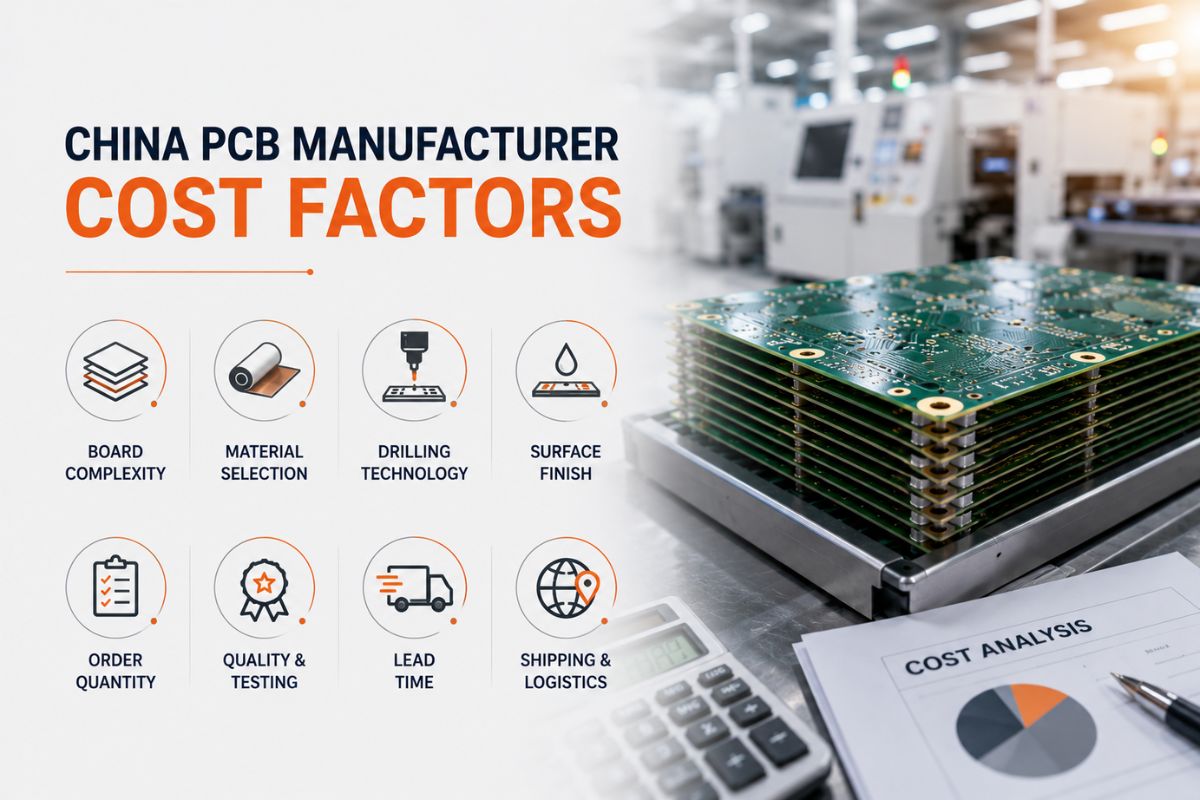
OEMs should avoid comparing suppliers by unit price only. A proper cost comparison should include PCB fabrication, BOM sourcing, assembly, inspection, testing, packaging, logistics, and post-delivery risk.
PCB Fabrication Cost
PCB fabrication cost is influenced by board size, material, layer count, copper weight, surface finish, controlled impedance, drill size, tolerance, routing, panel utilization, and special process requirements.
For complex designs, OEMs should provide complete Gerber or ODB++ files, stack-up requirements, fabrication drawings, impedance notes, and inspection criteria.
BOM and Component Sourcing Cost
BOM cost is often one of the largest cost drivers in PCB and PCBA projects. Component pricing depends on manufacturer part numbers, availability, MOQ, lead time, approved alternatives, lifecycle status, and supplier channel.
A complete BOM should include reference designators, MPNs, package type, quantity per board, descriptions, approved alternatives, do-not-populate notes, and sourcing restrictions if applicable.
Assembly and Testing Cost
Assembly cost depends on SMT placement count, component density, fine-pitch parts, BGA or QFN packages, double-sided assembly, through-hole components, manual insertion, inspection, and test requirements.
Testing may include AOI, X-ray, ICT, functional testing, firmware programming, burn-in, high-voltage test, or customer-specific validation. If testing is not included in the RFQ, the quoted price may look lower but fail to reflect the real production scope.
Logistics and Landed Cost
Landed cost includes freight, Incoterms, insurance, customs clearance, duties, packaging volume, return handling, and buffer inventory. For US and Europe OEMs, this is often more useful than factory unit price.
When requesting pricing, OEMs should use a clear PCB assembly quote structure that separates unit cost, NRE, tooling, test fixture, packaging, and shipping assumptions.
China PCB Manufacturer vs Vietnam PCB/PCBA Partner
A China PCB manufacturer can be a good fit for prototype speed and complex sourcing, while Vietnam may be a stronger option for OEMs seeking China+1 production, supply chain diversification, and stable EMS support outside China.
| Factor | China PCB Manufacturer | Vietnam PCB/PCBA Partner |
|---|---|---|
| Component ecosystem | Very mature and deep | Growing, often suitable with planned sourcing |
| Prototype speed | Strong for sourcing-heavy projects | Supplier-dependent |
| China+1 strategy | Not applicable | Strong fit |
| Assembly cost control | Case by case | Competitive for qualified EMS projects |
| Tariff exposure | Needs careful review | Needs HS code and origin review |
| Supply chain diversification | Lower if China-only | Higher for non-China production planning |
| Stable production | Strong with mature suppliers | Strong with a qualified EMS partner |
For a deeper comparison, OEMs can review PCBA manufacturer Vietnam vs China and evaluate sourcing strategy by product type, BOM maturity, testing needs, and long-term risk.
When a China PCB Manufacturer May Be the Right Choice
A China PCB manufacturer may be the right choice when the project is still in early development or requires fast access to many suppliers.
China may be suitable when:
- The product is in prototype or NPI stage
- The BOM changes frequently
- Custom mechanical parts are still being developed
- The product requires fast supplier access
- The OEM needs complex sourcing support
- The project requires rapid engineering changes
In these cases, China’s electronics ecosystem can still provide practical advantages. The key is to manage sourcing quality, documentation, test requirements, and component approval carefully.
When OEMs Should Consider a Vietnam Alternative
OEMs should consider Vietnam when the product is mature enough for stable production and the business needs a second manufacturing base outside China.
Vietnam may be a strong fit when:
- The OEM needs China+1 production
- The BOM is stable
- The design is production-ready
- Testing requirements are defined
- The project requires repeat production
- The OEM wants final assembly, testing, and packaging outside China
- The company wants to reduce single-country dependency
For companies comparing alternatives to China PCB assembly, Vietnam can be a practical option when supplier qualification is done carefully.
RFQ Checklist Before Choosing a China PCB Manufacturer
Before selecting a China PCB manufacturer, OEMs should prepare a complete RFQ package. The same package can also be used to compare Vietnam alternatives fairly.
| RFQ Item | Why It Matters |
|---|---|
| Gerber or ODB++ files | Defines PCB fabrication requirements |
| BOM with MPNs | Controls component sourcing accuracy |
| Approved vendor list | Reduces substitution risk |
| Pick-and-place file | Supports SMT setup and programming |
| Assembly drawing | Reduces polarity, placement, and orientation errors |
| Test plan | Defines inspection and validation scope |
| Quality standard | Clarifies acceptance criteria |
| Packaging specification | Avoids export packaging problems |
| Incoterms and shipping destination | Clarifies landed cost |
| Origin documentation requirements | Supports customs review |
OEMs evaluating Vietnam can use a PCBA manufacturer Vietnam RFQ checklist to compare suppliers by the same scope and reduce quote assumptions.
Questions to Ask Before Signing With a China PCB Manufacturer
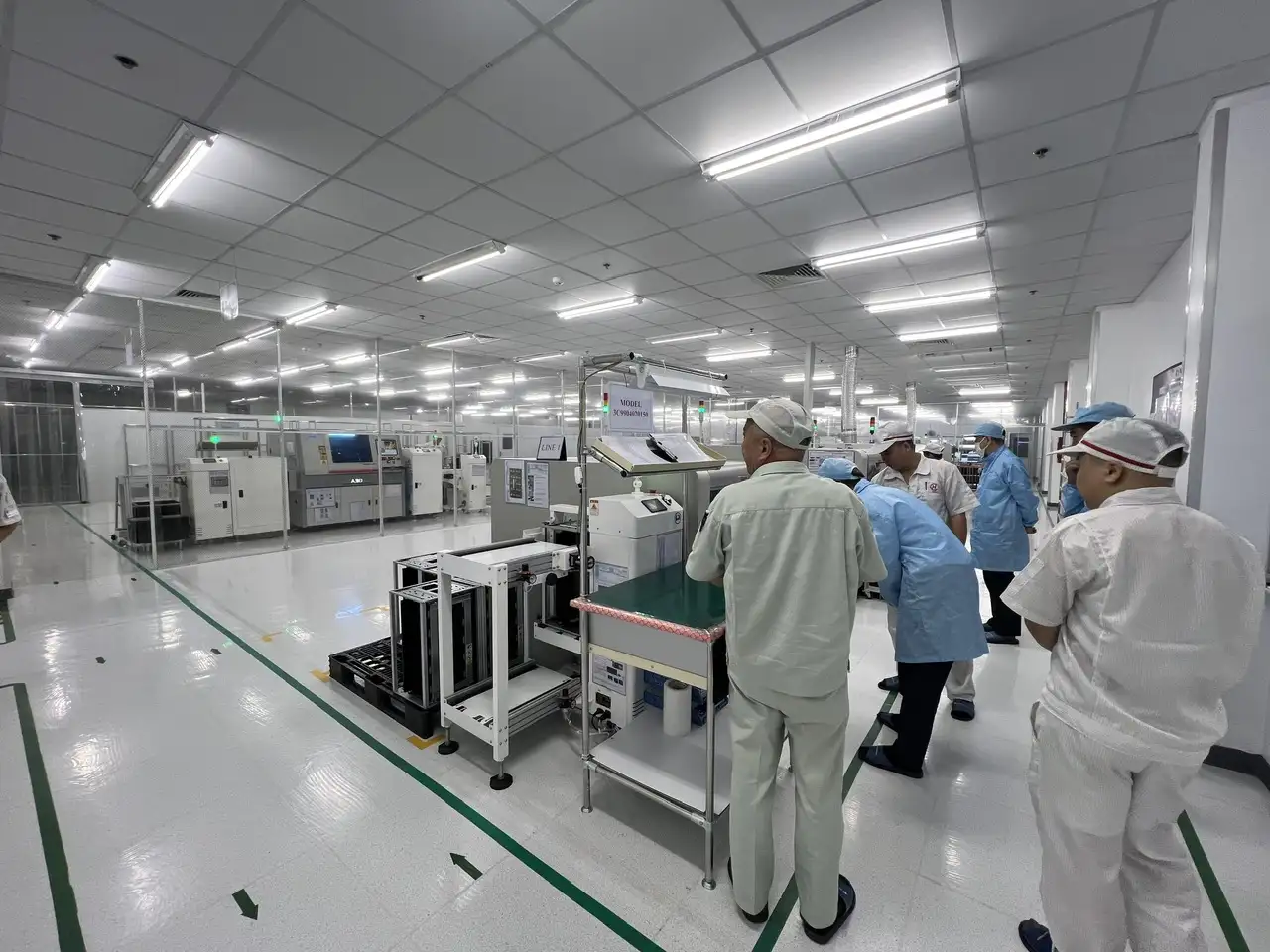
Before signing with a China PCB manufacturer, OEMs should ask detailed technical and commercial questions.
- What is included in the quote?
- What costs are excluded?
- Are components sourced from approved suppliers?
- Is OEM approval required for component substitutions?
- What inspection steps are included?
- Is functional testing included?
- Who owns test fixtures and tooling?
- How are engineering change orders managed?
- What quality reports are provided?
- What happens if delivery is delayed?
- What happens if field failures occur?
For production programs, OEMs should also complete electronics supplier due diligence before placing the first production order.
Quality Standards and Inspection Expectations
Quality should be defined by measurable acceptance criteria. Terms like “good quality” or “standard quality” are not enough for PCB assembly or PCBA production.
OEMs should define inspection requirements, test coverage, failure handling, rework approval, and production records. If IPC acceptance criteria are required, buyers can reference the official IPC-A-610 standard, which provides requirements for acceptance of electronic assemblies.
When comparing China and Vietnam, quality should be evaluated by process capability rather than country. A strong supplier should be able to explain its incoming inspection, SMT process control, AOI, ICT, functional testing, OQC, failure analysis, and traceability process.
How SHDC Supports OEMs Looking for a Vietnam PCB/PCBA Alternative
For OEMs comparing China PCB manufacturer options with Vietnam alternatives, SHDC Electronics Co., Ltd. can be evaluated as a Vietnam EMS Vietnam partner for component soldering, assembly, testing, and final packaging.
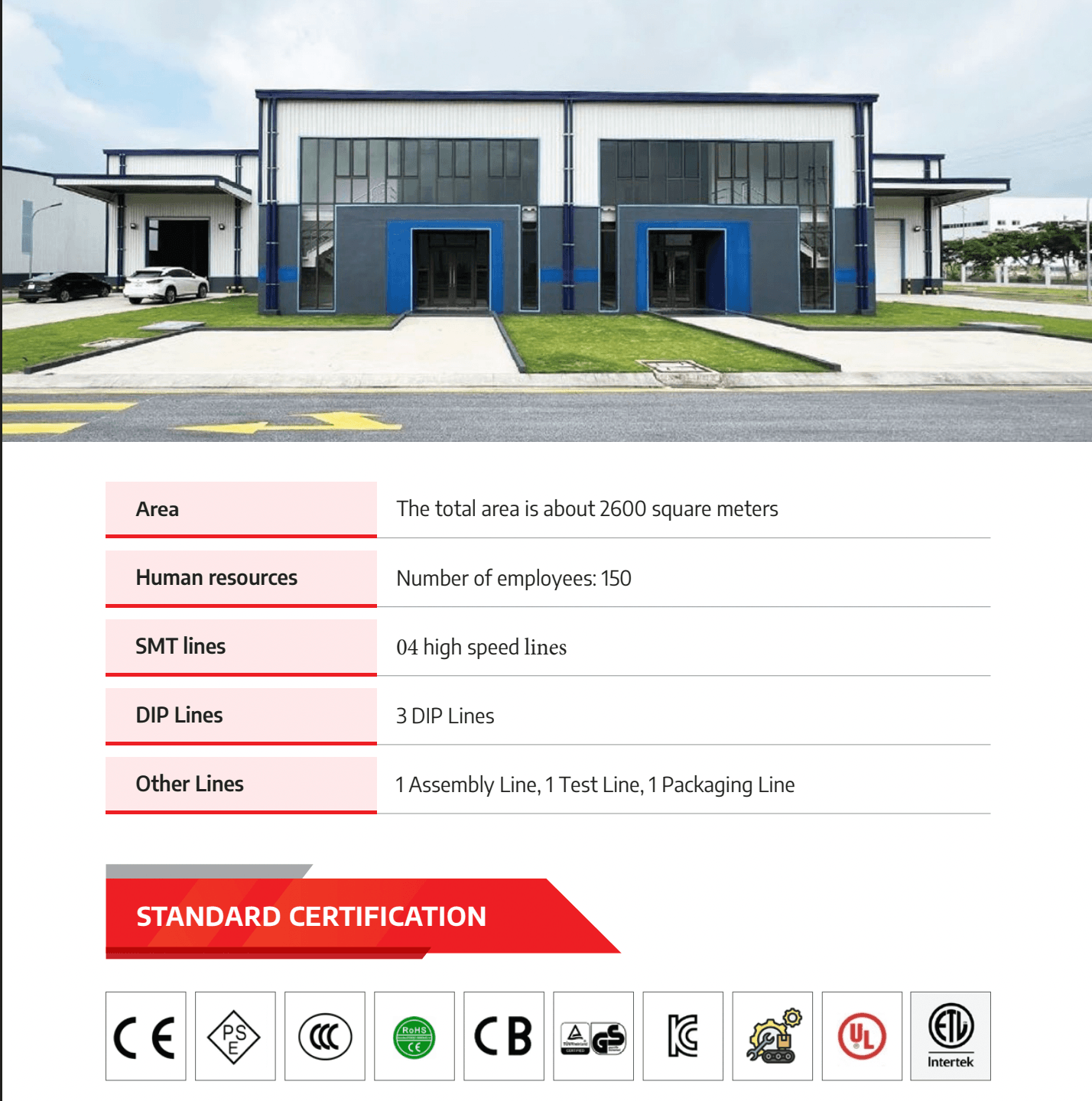
According to the SHDC company profile, SHDC provides Electronics Manufacturing Services from component soldering, assembly, and testing to final packaging. The profile lists a current factory service scope of about 2,600 square meters, 150 employees, 4 high-speed SMT lines, 3 DIP lines, 1 assembly line, 1 test line, and 1 packaging line.
The documented production process includes IQC inspection, warehouse, screen printing, mounting, reflow, AOI, component insertion, automatic soldering, ICT, FCT, visual inspection, OQC, packaging, and finished product warehouse.
The profile also lists production facilities including Yamaha SMT equipment, 3D SPI, 3D AOI, Kyoritsu ICT, wave soldering, reflow oven, component insert machine, high-voltage test, functional testing, aging test, and laser marking equipment.
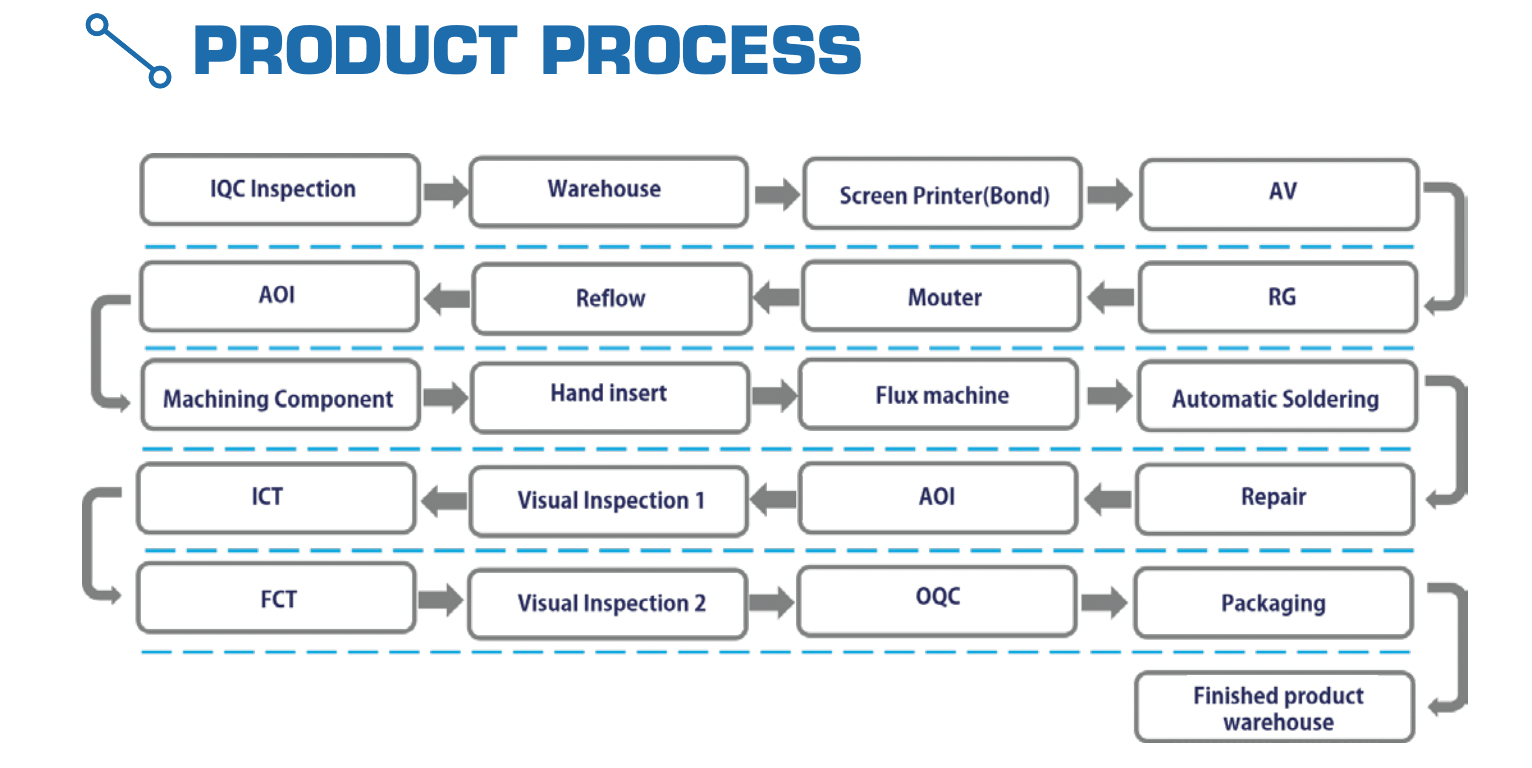
For OEMs considering Vietnam as a second production base, SHDC can be reviewed against project-specific requirements such as BOM maturity, SMT complexity, DIP needs, test process, packaging scope, and target volume.
>>>Read more: SHDC Full Service EMS in Vietnam: End-to-End Electronics Manufacturing for US Companies
China PCB Manufacturer or Vietnam Alternative: How OEMs Should Decide
The decision should depend on product maturity and sourcing priorities.
Choose a China PCB manufacturer if the project requires complex sourcing, frequent prototype iterations, custom mechanical development, or fast access to a dense electronics supplier network.
Consider Vietnam if the product is production-ready, the BOM is stable, testing requirements are clear, and the OEM wants a China+1 manufacturing base for long-term resilience.
For OEMs planning to transfer production, a production readiness checklist can help confirm that the BOM, Gerber files, assembly drawings, test fixtures, packaging, quality criteria, and forecast are ready before scaling.
Conclusion: Should OEMs Choose a China PCB Manufacturer?
A China PCB manufacturer may still be a strong option for complex sourcing, rapid prototyping, and supplier ecosystem depth. China remains important in the global electronics manufacturing landscape, especially for early-stage development and sourcing-heavy projects.
However, OEMs should not make the decision based only on unit price. Tariff exposure, country-of-origin rules, sourcing transparency, component substitution, quality control, testing, documentation, and supply chain concentration all affect the real cost and risk of sourcing from China.
Vietnam is a practical alternative for OEMs seeking China+1 production, stable EMS support, supply chain diversification, and qualified PCBA assembly outside China. The strongest approach is often not replacing China immediately, but building a structured sourcing strategy that balances China’s ecosystem strengths with Vietnam’s role as a resilient production base.
Send your Gerber files, BOM, assembly drawings, test requirements, and target volume to SHDC for a Vietnam PCB/PCBA manufacturing review.
FAQ About China PCB Manufacturer
What is a China PCB manufacturer?
A China PCB manufacturer is a supplier based in China that produces printed circuit boards. Some suppliers also provide PCBA assembly, component sourcing, testing, packaging, and turnkey electronics manufacturing support.
Is a China PCB manufacturer still a good option for OEMs?
Yes, a China PCB manufacturer can still be a good option for projects that require complex sourcing, fast prototyping, and access to a mature electronics supplier ecosystem. However, OEMs should evaluate total landed cost, quality systems, compliance risk, and supply chain concentration.
What are the risks of choosing a China PCB manufacturer?
Key risks may include tariff exposure, country-of-origin complexity, supply chain concentration, component substitution, documentation gaps, communication issues, and quality control differences between suppliers.
Is Vietnam a good alternative to China PCB manufacturing?
Vietnam can be a good alternative when the product is stable, the BOM is mature, testing requirements are defined, and the OEM wants a China+1 production base for PCB assembly, PCBA manufacturing, testing, and packaging.
What should OEMs include in a PCB manufacturing RFQ?
OEMs should include Gerber files, BOM with manufacturer part numbers, pick-and-place data, assembly drawings, test plans, quality standards, packaging specs, target quantities, lead time expectations, and shipping destination.
Should OEMs choose China or Vietnam for PCBA production?
China may be stronger for complex sourcing and early-stage development. Vietnam may be better for stable production, China+1 sourcing, supply chain diversification, and long-term EMS support outside China. The best choice depends on product maturity, BOM complexity, test requirements, landed cost, and risk strategy.