Tiếng Việt
 日本語
日本語
What Does EMS in Vietnam Mean for OEMs?
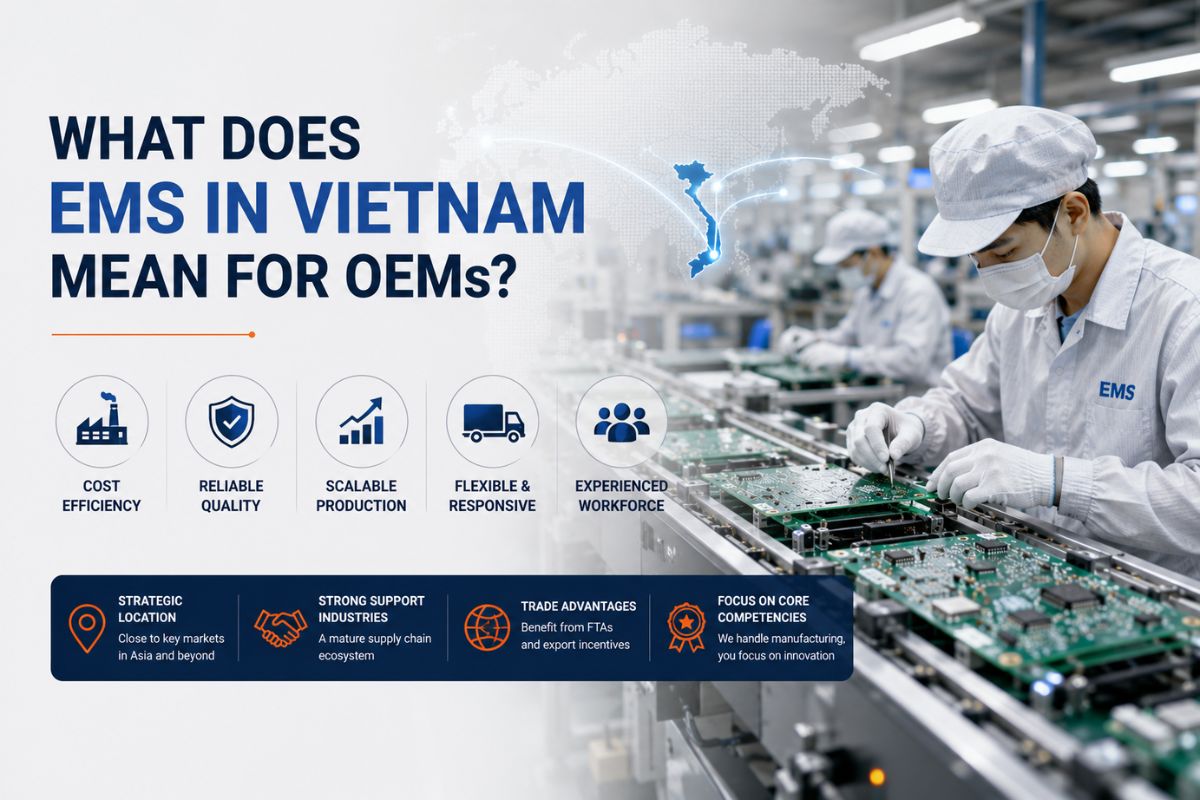
EMS stands for Electronics Manufacturing Services. In the context of EMS in Vietnam, it usually refers to manufacturers that help OEMs produce electronic products through services such as PCB assembly, PCBA manufacturing, component sourcing, testing, final assembly, and packaging.
A Vietnam EMS partner may support:
- PCB assembly and PCBA manufacturing
- SMT assembly
- DIP or through-hole assembly
- Component soldering
- Testing and inspection
- Functional testing
- Final assembly
- Labeling and packaging
- Production support for repeat orders
For OEMs comparing EMS Vietnam options, the main goal is to find a manufacturing partner that can support the required production scope, not just a supplier that can provide the lowest quote.
EMS vs PCB Assembly vs PCBA Manufacturing
OEMs should understand the difference between PCB assembly, PCBA manufacturing, and EMS before selecting a supplier.
PCB assembly usually refers to placing and soldering components onto a printed circuit board. This may include SMT assembly, through-hole assembly, or mixed assembly.
PCBA manufacturing is broader than basic assembly. It often includes assembled board production, inspection, testing, repair control, and production documentation.
EMS is the widest service model. It may include component sourcing, PCB assembly, PCBA manufacturing, testing, final assembly, packaging, and production management. For OEMs looking for broader manufacturing support, full turnkey electronics manufacturing may be more relevant than assembly-only service.
This distinction matters because two EMS quotes can look similar but include very different scopes. One supplier may quote only assembly labor, while another may include sourcing, inspection, testing, packaging, and documentation.
Why OEMs Are Evaluating EMS in Vietnam
OEMs are evaluating EMS in Vietnam for several reasons. Vietnam is often considered as part of a China+1 strategy, supply chain diversification plan, or long-term manufacturing footprint in Asia.
According to the Vietnam market overview from the International Trade Administration, Vietnam continues to be covered as an important commercial market for US companies. For electronics OEMs, this makes Vietnam relevant not only as a sales market but also as a manufacturing and supply chain location.
Common reasons OEMs consider EMS in Vietnam include:
- Reducing single-country dependency
- Building an alternative production base outside China
- Supporting export-oriented electronics manufacturing
- Improving supply chain resilience
- Accessing cost-conscious assembly and testing support
- Qualifying a long-term EMS partner for repeat production
For OEMs comparing Vietnam with China, a practical starting point is to review PCBA manufacturer Vietnam vs China and evaluate which location fits the product’s sourcing, assembly, testing, and compliance requirements.
Why Choosing the Right EMS Partner Matters
Selecting the wrong EMS partner can create hidden costs that are much higher than the savings from a low unit price. Poor supplier fit can lead to production delays, component substitution problems, weak testing coverage, documentation gaps, rework, scrap, or field failures.
A good EMS partner should support both technical and commercial alignment. Engineering teams need manufacturability feedback and test coverage. Purchasing teams need clear BOM responsibility and cost breakdown. Quality teams need inspection records and acceptance criteria. Operations teams need stable lead time and production planning.
Before choosing EMS in Vietnam, OEMs should evaluate whether the supplier can support the complete product lifecycle from RFQ to prototype, pilot run, and repeat production.
Key EMS Capabilities OEMs Should Evaluate in Vietnam
SMT Assembly Capability
SMT assembly is one of the core processes in electronics manufacturing. OEMs should evaluate whether the EMS partner has the equipment, process control, and inspection capability required for the board design.
Important SMT questions include:
- How many SMT lines does the supplier operate?
- Can the supplier handle fine-pitch components?
- Can it support BGA, QFN, QFP, or leadless packages?
- Can it process double-sided SMT boards?
- How is stencil printing controlled?
- How is reflow profiling managed?
- Is AOI included after SMT?
OEMs can also review SMT assembly Vietnam when comparing suppliers for surface-mount production capability.
DIP and Through-Hole Assembly Capability
Not every product is SMT-only. Many power electronics, industrial controllers, chargers, and embedded systems include connectors, relays, transformers, terminal blocks, switches, or large capacitors that require DIP or through-hole assembly.
When evaluating EMS in Vietnam, OEMs should ask whether the supplier supports:
- Manual component insertion
- Wave soldering
- Hand soldering when needed
- Connector and terminal block assembly
- Power component assembly
- Post-solder inspection
- Rework control
This is especially important for products with mixed SMT and DIP processes. A supplier may be strong in SMT but less suitable for boards with heavy through-hole content.
PCBA Testing Capability
Testing capability is one of the most important differences between a basic assembly shop and a reliable EMS partner. If testing is not defined early, the initial quote may exclude key validation steps.
Common testing and inspection methods include:
- Visual inspection
- Solder paste inspection
- Automated Optical Inspection
- X-ray inspection if required for hidden solder joints
- in-circuit testing
- Functional testing
- Firmware programming
- Aging test
- High-voltage test when applicable
- Custom test fixture support
For products with firmware, communication interfaces, power outputs, sensors, displays, or safety-related functions, OEMs should define test procedures and pass/fail criteria before production starts.
Final Assembly and Packaging
EMS in Vietnam can also support final production steps beyond board assembly. Depending on the product, this may include housing assembly, cable connection, labeling, barcode control, serial number tracking, ESD packaging, export cartons, and final packaging.
OEMs should ask whether the EMS partner can support:
- Final assembly
- Box build assembly
- Cable connection
- Labeling and barcode application
- Serial number management
- ESD-safe packaging
- Export carton requirements
- Customer-specific packaging instructions
If the project requires more than PCBA, OEMs should evaluate whether the supplier can support box build assembly services or final packaging as part of the manufacturing scope.
How to Evaluate Quality Control in an EMS Partner
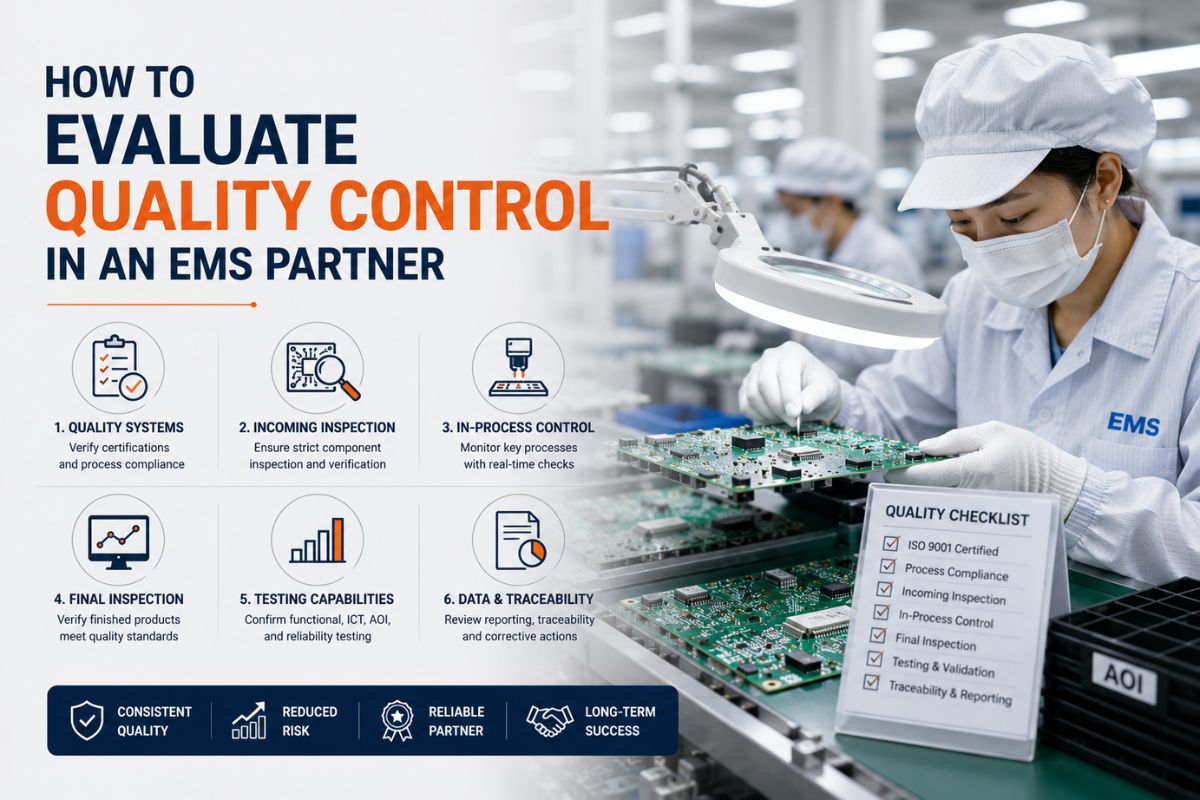
Incoming Quality Control — IQC
Quality control should begin before production. Incoming Quality Control helps verify materials, components, and PCBs before they enter the assembly process.
OEMs should ask how the EMS partner handles:
- Component verification
- PCB inspection
- Supplier documentation
- Lot tracking
- Material storage
- Moisture-sensitive device control if applicable
This matters because defects or incorrect components found late in production are more expensive to fix than issues caught during incoming inspection.
In-Process Quality Control
In-process control helps detect problems during production instead of waiting until final inspection. A strong EMS partner should have clear inspection checkpoints during SMT, reflow, DIP, testing, and repair.
Important checkpoints may include:
- Solder paste inspection
- First article inspection
- AOI after SMT
- Reflow profile control
- DIP inspection
- Repair records
- Process yield tracking
Final Quality Control — OQC
Outgoing Quality Control confirms that finished products meet defined requirements before shipment. For PCBA and EMS projects, OQC may include visual inspection, functional test review, packaging check, label verification, and shipment approval.
OEMs should ask whether the EMS partner can provide inspection records, test reports, nonconformance reports, or production traceability when required.
Acceptance Criteria and Quality Standards
Quality expectations should be written clearly. If the project uses IPC acceptance criteria, OEMs can reference the official IPC-A-610, which provides requirements for acceptance of electronic assemblies.
OEMs should define:
- Assembly acceptance criteria
- Cosmetic criteria
- Functional pass/fail criteria
- Rework approval process
- Traceability requirements
- Inspection report requirements
Do not assume that “standard quality” means the same thing to both parties. Quality requirements must be included in the RFQ, purchase order, or manufacturing agreement.
Questions OEMs Should Ask Before Choosing EMS in Vietnam
Manufacturing Scope Questions
- Do you support PCB assembly only or full EMS?
- Do you provide component sourcing?
- Do you support both SMT and DIP assembly?
- Do you support testing and final packaging?
- Can you support prototype, pilot, and repeat production?
- What is included and excluded from the quote?
Sourcing Questions
- Can you source all BOM items?
- Do you support turnkey, consigned, or hybrid sourcing?
- How do you handle long-lead parts?
- Is OEM approval required before substitution?
- Can you recommend approved alternatives?
- Who owns excess inventory?
For broader sourcing models, OEMs may compare turnkey PCBA manufacturer in Vietnam options with consigned or hybrid sourcing.
Testing Questions
- What tests are included by default?
- Can you follow customer test procedures?
- Can you support ICT or FCT?
- Who owns the test fixture?
- Can you provide test records?
- How are failed units handled?
Quality and Documentation Questions
- What inspection records can you provide?
- How do you manage file revisions?
- How do you handle nonconforming products?
- Can you support traceability?
- How are engineering changes controlled?
Before selecting a supplier, OEMs should conduct electronics supplier due diligence to review factory capability, quality process, documentation, and communication standards.
EMS in Vietnam Supplier Selection Checklist
| Evaluation Area | What OEMs Should Check | Why It Matters |
|---|---|---|
| SMT capability | Lines, placement capability, fine-pitch support | Confirms assembly feasibility |
| DIP capability | Through-hole process and inspection | Important for connectors and power parts |
| Testing | AOI, ICT, FCT, programming, aging test | Reduces defect risk |
| Sourcing model | Turnkey, consigned, or hybrid | Clarifies BOM responsibility |
| Quality process | IQC, in-process inspection, OQC, reports | Improves production control |
| Documentation | Revision control, test records, ECO process | Prevents production mistakes |
| Packaging | ESD, barcode, carton labels | Supports export readiness |
| Lead time | Sourcing, assembly, testing, packaging, shipping | Supports production planning |
| Scalability | Prototype, pilot, and mass production support | Supports long-term growth |
Turnkey, Consigned, or Hybrid EMS Model: Which Should OEMs Choose?
Turnkey EMS in Vietnam
In a turnkey model, the EMS partner sources PCBs, components, and production materials, then handles assembly, testing, and packaging. This model can reduce purchasing workload for the OEM, but it requires a strong BOM, approved vendor list, and substitution approval rules.
Consigned EMS Model
In a consigned model, the OEM provides some or all components to the EMS partner. This can be useful when the OEM already owns inventory or needs strict control over critical parts.
The contract should define extra component quantity for attrition, material receiving inspection, storage conditions, and responsibility for late or missing parts.
Hybrid EMS Model
A hybrid model is often practical for international OEMs. The OEM supplies critical or restricted components, while the EMS partner sources standard components, PCBs, and production materials.
This model balances control and efficiency. It can work well when the BOM includes both standard materials and high-value or customer-controlled components.
Cost Factors When Working With EMS in Vietnam
EMS pricing depends on the complete manufacturing scope. OEMs should not compare quotes only by unit price.
PCB and PCBA Complexity
Cost is affected by board size, layer count, component density, fine-pitch ICs, BGA or QFN packages, double-sided SMT, and through-hole content.
BOM and Component Sourcing
BOM cost depends on manufacturer part numbers, MOQ, lead time, lifecycle status, approved alternatives, and sourcing channel. A complete BOM improves quote accuracy and reduces sourcing risk.
Testing and Fixture Cost
Testing cost may include AOI, ICT, FCT, firmware programming, burn-in, high-voltage test, custom fixtures, and operator time. If testing is not included in the RFQ, the quote may be incomplete.
Packaging and Logistics
Packaging and logistics may include ESD bags, anti-static trays, labels, barcodes, cartons, export packaging, shipping destination, Incoterms, and customs documentation.
For cost planning, OEMs should request a detailed PCB assembly quote and compare PCB assembly cost by category, not just by headline unit price.
Common Mistakes When Choosing an EMS Partner in Vietnam
Comparing Only Unit Price
The lowest quote may exclude testing, fixtures, packaging, documentation, or engineering support. OEMs should compare total manufacturing scope and total landed cost.
Sending an Incomplete RFQ Package
Missing BOM data, Gerber files, pick-and-place files, assembly drawings, or test plans can lead to inaccurate quotes and delays.
A structured PCBA manufacturer Vietnam RFQ checklist helps OEMs prepare complete files before asking for pricing.
Not Defining Component Substitution Rules
Unapproved component substitution can affect performance, quality, reliability, or compliance. OEMs should define approved alternatives and require written approval for critical parts.
Ignoring Test Strategy
If the test plan is missing, the EMS partner may quote assembly without ICT, FCT, firmware programming, or custom test fixtures.
Skipping Pilot Production
Moving directly from RFQ to mass production can create risk. A pilot build helps validate process stability, test coverage, documentation, packaging, and communication.
How OEMs Should Qualify an EMS in Vietnam
Step 1: Prepare a Complete RFQ Package
The RFQ package should include Gerber files, BOM with MPNs, pick-and-place data, assembly drawings, test procedures, quality requirements, packaging specs, quantity forecast, and shipping destination.
Step 2: Request DFM and BOM Review
A qualified EMS partner should be able to review manufacturability and sourcing risks before production. A practical DFM for electronics manufacturing review can check pad design, component spacing, fiducials, panelization, connector placement, and assembly access.
For more structured review, OEMs can also use a DFM checklist before releasing a product for production.
Step 3: Review DFT and Test Coverage
Testability should be reviewed early. Design for testability helps ensure that test points, programming access, fixture contact areas, and functional test coverage are practical for production.
Step 4: Compare Quotes by Scope
Compare BOM cost, assembly cost, testing cost, NRE, packaging, lead time, quote exclusions, and quality documentation. Do not compare suppliers only by unit price.
Step 5: Run Prototype or Pilot Build
A pilot build allows OEMs to validate yield, testing, communication, packaging, and documentation before moving to higher volume.
Step 6: Complete Production Readiness Review
Before scaling, OEMs should complete a Production Readiness Checklist to confirm BOM, files, test procedures, quality criteria, packaging, and forecast are ready for mass production.
EMS in Vietnam vs China: When Should OEMs Compare Both?
China may still be strong for complex sourcing, rapid prototype iteration, custom tooling, and supplier ecosystem depth. Vietnam may be better when the product is stable, the BOM is mature, and the OEM wants China+1 production or supply chain diversification.
For sourcing strategy, OEMs should consider:
- China for complex sourcing and early development
- Vietnam for qualified production, assembly, testing, and packaging
- Common BOM and test procedures across suppliers
- Shared quality standards
- Clear engineering change control
If China exposure is part of the decision, OEMs should review official China Section 301 tariff actions and supply chain documentation expectations such as UFLPA importer guidance when relevant to their product and sourcing route.
For a broader strategy view, OEMs can review electronics supply chain diversification and compare Vietnam with other sourcing locations.
How SHDC Supports EMS Projects in Vietnam
For OEMs evaluating EMS in Vietnam, SHDC Electronics Co., Ltd. can be reviewed as a Vietnam EMS partner for projects involving component soldering, assembly, testing, and final packaging.
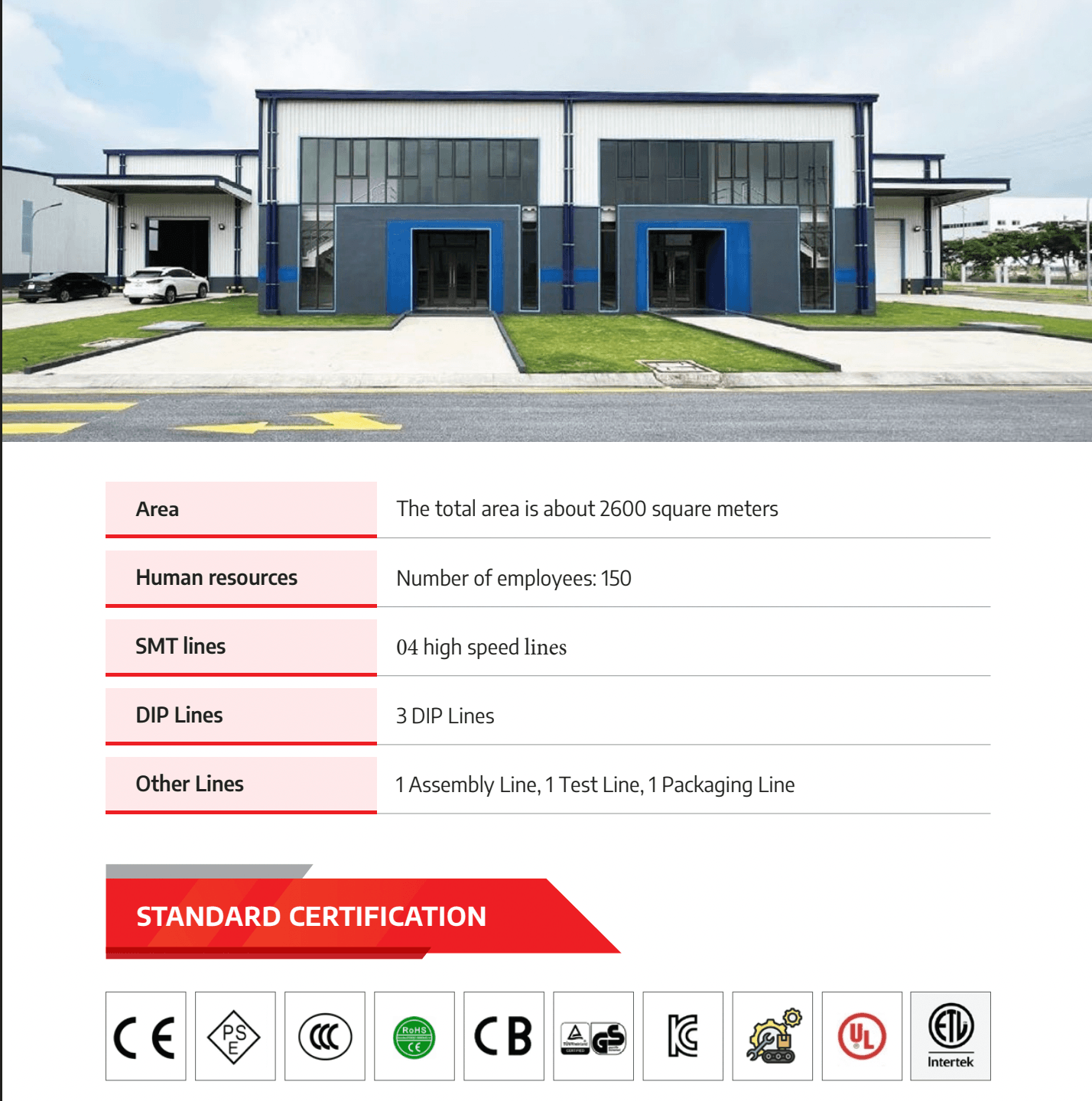
According to the SHDC company profile, SHDC provides Electronics Manufacturing Services from component soldering, assembly, and testing to final packaging. The profile lists a current factory service scope of about 2,600 square meters, 150 employees, 4 high-speed SMT lines, 3 DIP lines, 1 assembly line, 1 test line, and 1 packaging line.
The documented production process includes IQC inspection, warehouse, screen printing, mounting, reflow, AOI, component insertion, automatic soldering, ICT, FCT, visual inspection, OQC, packaging, and finished product warehouse.
The profile also lists production facilities including Yamaha SMT equipment, 3D SPI, 3D AOI, Kyoritsu ICT, wave soldering, reflow oven, component insert machine, high-voltage test, functional testing, aging test, and laser marking equipment.
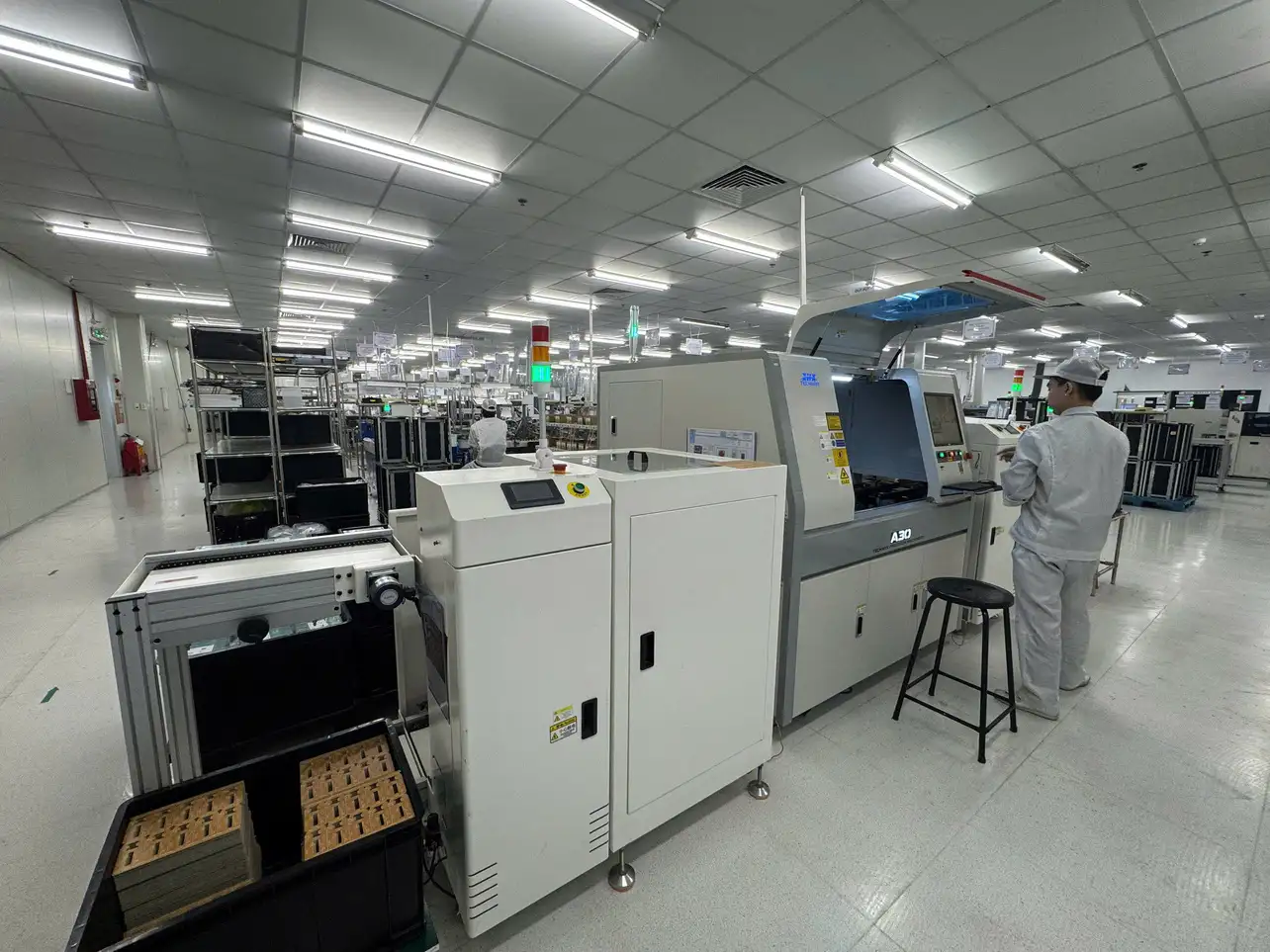
For OEMs comparing electronics manufacturing services company options, SHDC can be evaluated based on project-specific requirements such as BOM maturity, SMT complexity, DIP needs, testing process, packaging scope, and target production volume.
Conclusion: Choosing the Right EMS in Vietnam Requires More Than Price
Choosing EMS in Vietnam should be based on technical capability, production process, sourcing model, testing coverage, quality control, documentation, communication, lead time, and production readiness.
A good EMS partner should help OEMs reduce manufacturing risk, not simply provide a low quote. Before selecting a supplier, OEMs should prepare a complete RFQ package, define testing requirements, review DFM and DFT, clarify sourcing responsibility, run a pilot build, and complete production readiness review before scaling.
Send your BOM, Gerber files, assembly drawings, testing requirements, and target volume to SHDC for a Vietnam EMS manufacturing review.
FAQ About EMS in Vietnam
What does EMS in Vietnam mean?
EMS in Vietnam refers to electronics manufacturing services provided by Vietnam-based manufacturers. These services may include PCB assembly, PCBA manufacturing, component sourcing, SMT assembly, DIP assembly, testing, final assembly, and packaging.
How do OEMs choose the right EMS partner in Vietnam?
OEMs should evaluate SMT and DIP capability, testing process, sourcing model, quality control, documentation, communication, lead time, packaging support, and scalability from prototype to repeat production.
Is Vietnam a good location for EMS manufacturing?
Vietnam can be a suitable EMS location for OEMs seeking China+1 production, supply chain diversification, cost-conscious assembly, testing support, and export-oriented electronics manufacturing.
What should OEMs include in an EMS RFQ?
OEMs should include Gerber files, BOM with manufacturer part numbers, pick-and-place file, assembly drawing, test procedure, quality requirements, packaging specifications, target quantity, and shipping destination.
What is the difference between EMS and PCBA manufacturing?
PCBA manufacturing focuses on assembled circuit boards. EMS is broader and may include sourcing, PCB assembly, PCBA manufacturing, testing, final assembly, packaging, and production support.
Should OEMs choose turnkey or consigned EMS in Vietnam?
Turnkey EMS is suitable when OEMs want the EMS partner to manage sourcing and production. Consigned EMS is suitable when OEMs control critical components. Hybrid EMS is often useful when the OEM provides key parts and the EMS partner sources standard production materials.