
 Tiếng Việt
 日本語
日本語
A printed circuit board can operate reliably during laboratory testing yet fail after months of exposure to humidity, condensation, dust or airborne contaminants. These environmental conditions can contribute to corrosion, surface leakage and unstable electrical performance, particularly in industrial, outdoor and high-impedance electronics. A properly controlled conformal coating PCB process adds a thin insulating polymer layer over the assembled board, solder joints and selected components. However, coating quality depends on much more than choosing a resin and spraying it onto the PCBA.
Reliable protection requires the manufacturer to control:
- PCB cleanliness before coating
- Material compatibility
- Coating and keep-out areas
- Masking
- Application parameters
- Film thickness
- Curing
- Inspection
- Electrical testing
- Production traceability
This guide explains how US OEMs should select conformal coating materials, define application requirements and evaluate process control before releasing a coated PCB assembly into production.
What Is Conformal Coating on a PCB?
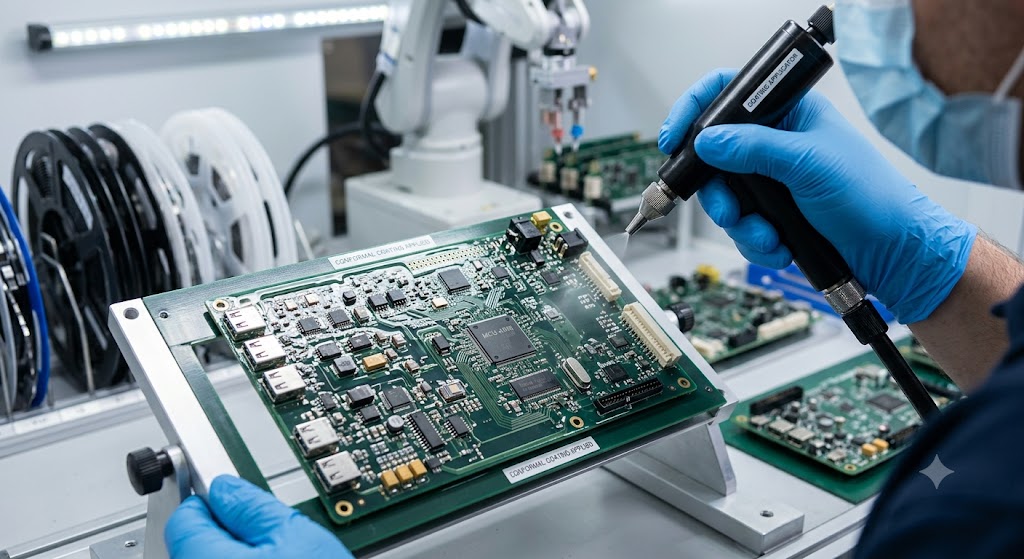
Conformal coating is a thin electrical-insulating compound applied to a completed printed circuit board assembly. It follows—or “conforms to”—the contours of the PCB, solder joints, component bodies and exposed conductors.
The coating is generally used to reduce the effects of:
- Humidity and condensation
- Airborne contamination
- Dust and particulate matter
- Salt-containing environments
- Chemical vapors
- Corrosion
- Surface leakage
- Electrical arcing between exposed conductors
The IPC-CC-830C conformal coating standard establishes qualification and conformance requirements for electrical-insulating compounds used as conformal coatings. It addresses the coating material itself; it does not replace the need for product-specific drawings, process instructions or acceptance criteria. (IPC Shop)
For OEMs unfamiliar with the upstream manufacturing stages, SHDC’s guide to the PCBA manufacturing process explains how fabrication data, component placement, soldering, inspection and testing are combined before any secondary protection process is added.
Conformal Coating vs. Solder Mask
Solder mask and conformal coating perform different functions.
| Factor | Solder mask | Conformal coating |
|---|---|---|
| Applied during | Bare PCB fabrication | After PCB assembly |
| Main coverage | Copper traces and PCB surface | PCB, solder joints and selected components |
| Primary purpose | Protect copper and control soldering | Reduce environmental exposure |
| Covers component bodies | No | Sometimes |
| Can be selectively applied | Defined during PCB fabrication | Defined by coating drawing and masking |
Solder mask remains part of the fabricated board. Conformal coating is a separate post-assembly process that must be coordinated with cleaning, testing, masking and packaging.
Conformal Coating vs. Potting
Conformal coating is normally a thin film that follows the surface of the assembly. Potting or encapsulation uses a larger volume of resin to partially or fully surround the PCB.
Potting may provide greater mechanical support or environmental isolation, but it also increases:
- Weight
- Material usage
- Cure time
- Thermal-management complexity
- Difficulty of failure analysis
- Difficulty of component replacement
Conformal coating is typically more practical when the assembly must remain accessible for inspection, testing or localized rework.
Is Conformal Coating Waterproof?
Conformal coating should not automatically be described as making a PCB waterproof.
It can improve resistance to moisture and contamination, but overall protection still depends on:
- Coating chemistry
- Film integrity
- Coverage around component edges
- PCB cleanliness
- Connector design
- Enclosure sealing
- Water pressure and duration
- Mechanical damage during assembly
- Environmental cycling
Even highly conformal vapor-deposited coatings require correct masking, process control and product-level validation. A coating should therefore be treated as one part of an environmental-protection strategy, not as a universal substitute for a sealed enclosure or potting. (Specialty Coating Systems)
When Does a PCB Need Conformal Coating?
Not every PCBA requires coating. The decision should be based on environmental risk, product life and the consequences of field failure.
Conformal coating may be appropriate when a product is exposed to:
- High relative humidity
- Condensation caused by temperature cycling
- Outdoor air
- Salt mist
- Industrial dust
- Sulfur-containing atmospheres
- Chemical processing environments
- Agricultural contaminants
- Cleaning fluids
- High-voltage surface leakage risks
- Long operating periods without maintenance
Common applications include:
- Industrial control equipment
- Energy meters
- HVAC controllers
- Outdoor IoT devices
- EV charging equipment
- Automotive electronics
- Water-treatment systems
- Power supplies
- Marine electronics
- Agricultural equipment
- Appliance control boards
The product environment should be defined before the material is selected. “Industrial use” is not precise enough. An OEM should state the likely chemicals, humidity range, operating temperature, condensation risk and expected service life.
When Coating May Not Be Necessary
Coating may provide limited value when:
- The PCB operates inside a well-sealed enclosure.
- The product remains in a controlled indoor environment.
- Environmental exposure is low.
- Sensors or RF circuits may be affected by the coating.
- Frequent field repair is expected.
- Masking and inspection costs exceed the risk being controlled.
The correct engineering question is not “Should all boards be coated?” It is:
What environmental failure mechanisms must this assembly survive, and what protection method addresses those mechanisms?
Conformal Coating Standards US OEMs Should Know
IPC-CC-830C
IPC-CC-830C establishes qualification and conformance requirements for conformal coating compounds.
An OEM should not interpret an IPC-CC-830-qualified material as automatic approval of the entire production process. The following still need to be defined:
- Exact material and product code
- Approved alternatives
- Required coated surfaces
- No-coat areas
- Film-thickness limits
- Cure conditions
- Inspection criteria
- Electrical testing
- Environmental qualification
The standard establishes requirements for insulating compounds; the manufacturer must still develop and control the application process for the actual assembly.
IPC-HDBK-830A
The IPC-HDBK-830A conformal coating handbook provides guidance for designers and users who need to understand coating types, material properties, board design, application and implementation.
It is particularly useful during:
- Product design
- Material comparison
- Process development
- Masking planning
- Inspection planning
- Rework strategy development
The handbook is guidance rather than a replacement for an OEM-controlled drawing or acceptance specification.
IPC-A-610J
IPC-A-610J is an acceptance standard for completed electronic assemblies. It includes criteria relevant to conformal coating coverage and workmanship.
The acceptance decision should consider:
- Product class
- Customer drawings
- Location of the condition
- Electrical impact
- Required coverage
- Evidence of delamination, cracking or contamination
A bubble or void should not be rejected solely because it is visible. Its location, size and effect on the assembly must be evaluated against the applicable acceptance criteria.
IPC Test Methods
Environmental and electrical qualification may also refer to the IPC-TM-650 test-method system. Depending on the product, testing may include insulation resistance, moisture exposure, adhesion or hydrolytic stability.
The test plan should be selected according to product risk rather than copied from an unrelated assembly.
Main Types of Conformal Coating Materials
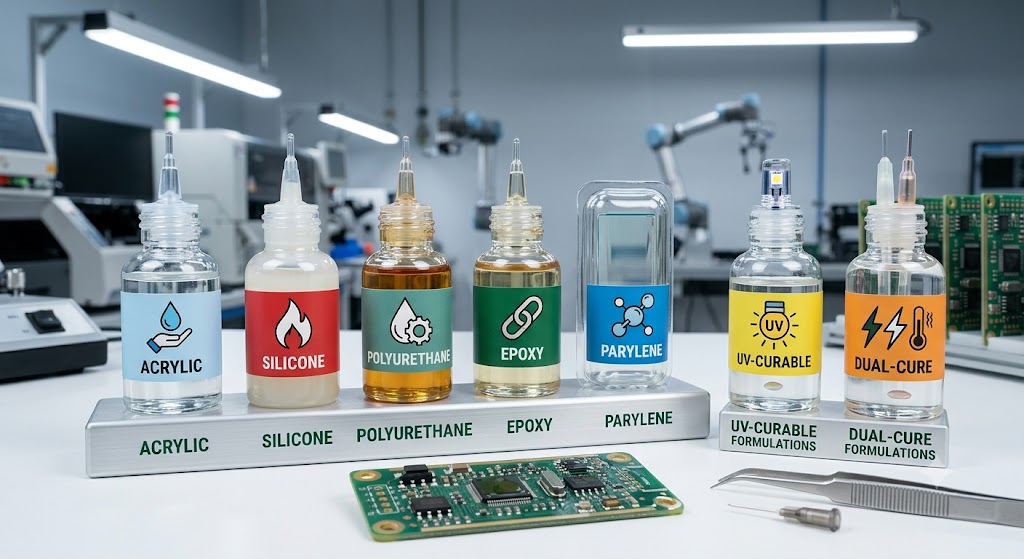
No coating chemistry is suitable for every PCB, environment and manufacturing process.
The most common material families include:
- Acrylic resin
- Silicone resin
- Polyurethane or urethane resin
- Epoxy resin
- Parylene
- UV-curable or dual-cure formulations
The properties of individual products vary significantly, even within the same chemistry. The final decision must therefore use the coating manufacturer’s technical data sheet and product-level qualification results.
Acrylic Conformal Coating
Acrylic coatings are commonly considered for general electronics because they are relatively straightforward to apply and can often be removed more easily than harder coating systems.
Potential advantages
- Convenient application
- Relatively fast solvent evaporation
- Good visibility during inspection
- Easier localized rework
- Availability in spray, dip and brush formats
Main limitations
- Chemical resistance may be lower than some urethane or epoxy systems.
- Solvent-based materials require ventilation and storage controls.
- The coating may soften when exposed to incompatible cleaning agents.
- Cure and final properties depend on solvent removal.
Acrylic may be suitable for commercial and general industrial products where moisture and contamination are the primary concerns and repairability remains important.
A manufacturer should still confirm compatibility with flux residues, labels, connectors and plastics before approval.
Silicone Conformal Coating
Silicone coatings are frequently considered for assemblies exposed to temperature cycling because the cured material can remain flexible across changing conditions.
Potential advantages
- Flexibility
- Accommodation of thermal expansion
- Suitability for some high-temperature applications
- Moisture protection
- Availability in UV-, moisture- and heat-cure systems
Main limitations
- Removal and rework can be more difficult than with acrylic.
- Uncontrolled silicone contamination can affect other bonding or coating operations.
- A soft coating does not automatically provide high abrasion resistance.
- Cure conditions must be followed carefully.
Some dual-cure silicone coatings use UV exposure for rapid surface cure and atmospheric moisture to complete curing in shadowed areas. Henkel, for example, describes a UV/moisture system designed to protect PCBs while providing secondary cure where direct light cannot reach.
>>>You May Also Like: PCBA Failure Analysis: Root Cause Investigation, Verification and CAPA
Polyurethane Conformal Coating
Polyurethane, also called urethane, is often considered when resistance to moisture and chemicals is more important than easy rework.
Potential advantages
- Strong resistance to many environmental contaminants
- Good adhesion
- Durable coating film
- Suitability for industrial applications
Main limitations
- Difficult removal
- Longer or more sensitive cure processes for some formulations
- Potential worker-safety and ventilation requirements
- Risk of damaging the assembly during rework
The term “chemical resistant” is not sufficient for material approval. The OEM should identify the actual fluids, vapors or cleaning agents the product may encounter and test the selected coating against them.
Epoxy Conformal Coating
Epoxy coatings can provide strong adhesion, abrasion resistance and chemical resistance.
They may be considered for assemblies where:
- Mechanical durability is important.
- Rework is unlikely.
- The operating environment is severe.
- A rigid protective film is acceptable.
However, epoxy can make repair extremely difficult and may transfer stress to components or solder joints. Two-component systems also require accurate mixing and pot-life control.
Epoxy should therefore be selected only after reviewing:
- Board flex
- Thermal cycling
- Component fragility
- Rework strategy
- Mix-ratio controls
- Cure validation
Parylene Coating
Parylene differs from liquid conformal coatings because it is deposited from a vapor in a controlled chamber.
The vapor-deposition process allows coating material to reach complex surfaces and small spaces that may be difficult to cover with conventional spray or dip methods. It can also create a relatively uniform film at low thickness.
Potential advantages
- Uniform coverage
- Thin coating film
- Access to complex geometry
- Strong dielectric performance
- Room-temperature deposition for many processes
Main limitations
- Specialized vacuum equipment
- Higher processing cost
- Detailed masking requirements
- Difficult removal
- Longer production cycle
- Complex localized repair
Parylene masking is especially important because the vapor can enter any accessible area. Connectors, contacts and test points must be protected before deposition.
UV-Curable and Dual-Cure Coatings
UV-curable coatings can reduce cure time and support automated production. However, UV light cannot directly reach every area of a populated PCBA.
Tall components, connectors and low-clearance features can create shadowed areas. A dual-cure material may use moisture or heat to complete curing in areas that do not receive sufficient UV energy.
The manufacturer should control:
- UV intensity
- Lamp condition
- Exposure time
- Conveyor speed
- Coating thickness
- Distance from the UV source
- Secondary-cure conditions
- Shadow-area verification
Dymax’s technical guidance recommends evaluating the actual component topography and intended application process because shadow areas vary significantly between board designs.
Conformal Coating Material Comparison
| Material | Moisture resistance | Chemical resistance | Temperature flexibility | Reworkability | Common use considerations |
|---|---|---|---|---|---|
| Acrylic | Medium | Low–medium | Medium | Relatively easy | General electronics and repairable assemblies |
| Silicone | High | Formulation-dependent | High | Medium–difficult | Temperature cycling and flexible protection |
| Polyurethane | High | High | Medium | Difficult | Industrial and chemical exposure |
| Epoxy | High | High | Low–medium | Very difficult | Durable, low-rework applications |
| Parylene | High | High | High | Difficult | Thin, uniform coating and complex geometry |
| UV/dual cure | Formulation-dependent | Formulation-dependent | Formulation-dependent | Formulation-dependent | Automated, high-volume production |
This table should be used for initial screening only. Material selection must be confirmed using the manufacturer’s technical documentation and qualification testing.
How to Select the Right Conformal Coating PCB Material
Define the Operating Environment
Before requesting a quotation, the OEM should document:
- Minimum and maximum operating temperatures
- Storage temperatures
- Humidity range
- Condensation risk
- Outdoor exposure
- Dust and particulate exposure
- Salt or marine exposure
- Chemical names and concentrations
- Expected service life
- Whether the PCB is powered during exposure
Without this information, the coating supplier or EMS manufacturer cannot make a technically defensible recommendation.
Review Electrical Requirements
The coating decision should also consider:
- Operating voltage
- Creepage and clearance
- Leakage-current limits
- High-impedance circuits
- RF performance
- Sensor sensitivity
- Test-point access
- Grounding contacts
- High-voltage areas
Coating should not be used to conceal an inadequate PCB layout. Creepage, clearance and product-safety requirements must be addressed at the design stage.
A formal DFM checklist for PCBA manufacturing can help identify coating keep-out zones, component-access requirements and layout risks before production tooling is released.
Verify Component Compatibility
Some components may be affected if coating blocks an opening, changes optical transmission or alters thermal performance.
Items that require review include:
- Connectors
- Switches
- Relays
- Microphones
- Speakers
- Pressure sensors
- Gas sensors
- Humidity sensors
- MEMS devices
- Displays
- LEDs
- Optical components
- RF antennas
- Adjustment potentiometers
- Heat-transfer surfaces
The manufacturer should check both the component datasheet and the coating-material compatibility data.
Consider Rework
A coating may perform well in the field but create significant repair costs.
The OEM should define:
- Whether component replacement is allowed
- How the coating will be removed
- Which tools or solvents are approved
- How the repaired area will be cleaned
- How recoating will be performed
- How repaired units will be identified
- Whether electrical and environmental testing must be repeated
Where field repair is likely, easier-to-remove acrylic systems may provide a practical advantage over epoxy or parylene.
Design for Conformal Coating
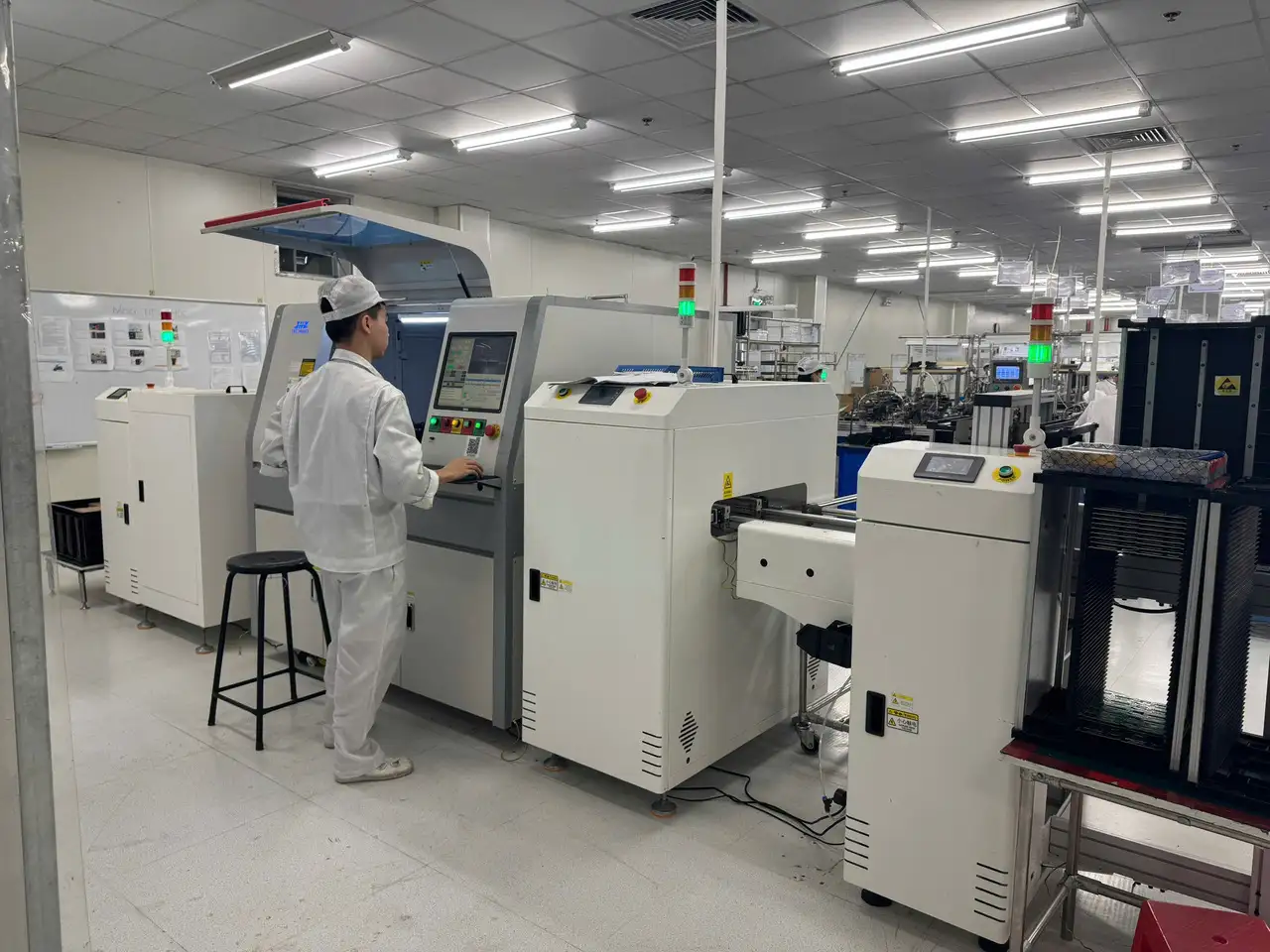
Coating requirements should appear on a controlled assembly drawing. A purchase-order note stating “apply conformal coating” is not detailed enough for production.
The drawing should identify:
- Coated side or sides
- Full or selective coverage
- Coating boundaries
- Edge requirements
- Keep-out areas
- Material and approved alternatives
- Film-thickness requirements
- Cure requirements
- Inspection method
- Acceptance criteria
- Rework restrictions
Components That May Require Masking
Common masking candidates include:
- Connector contacts
- Sockets
- Test points
- Programming headers
- Edge fingers
- Grounding contacts
- Switches
- Vented relays
- Sensors
- Displays
- Optical surfaces
- Mechanical mating surfaces
- Heatsink contact areas
- Antennas
These are not universal rules. Final masking requirements depend on the component design and product function.
Layout Considerations
Designers can simplify coating by:
- Providing space around connectors
- Grouping keep-out areas
- Avoiding coating boundaries through fine-pitch devices
- Positioning test points for easy masking
- Providing tooling holes
- Reducing capillary traps
- Avoiding deep pockets where coating can pool
- Considering component shadowing for UV cure
- Providing access for selective-coating valves
Early cooperation between the design team and the EMS supplier can reduce masking labor and improve process repeatability.
PCB Preparation Before Conformal Coating
Why Cleanliness Matters
A coating does not remove contamination. It may trap contamination against the assembly.
Potential contaminants include:
- Flux residues
- Ionic residues
- Fingerprints
- Dust
- Oils
- Cleaning-agent residue
- Moisture
- Manufacturing debris
If contamination remains beneath the coating, it can contribute to poor adhesion, corrosion, dewetting or electrical leakage.
Before coating, the manufacturer should define:
- Flux type
- Cleaning requirement
- Approved cleaning chemistry
- Rinse process
- Drying process
- Cleanliness verification
- Maximum time between cleaning and coating
A “no-clean” flux designation should not automatically be interpreted as approval to apply every coating directly over the residue. Compatibility must be validated for the specific flux and coating combination.
Drying and Pre-Bake
Drying or pre-baking may be used to reduce moisture before coating. However, the process must remain compatible with:
- Components
- Labels
- Plastics
- PCB laminate
- Adhesives
- Existing solder joints
There is no single pre-bake recipe suitable for every PCBA. Time and temperature should be based on engineering evaluation and material specifications.
Masking
Masking methods may include:
- Tape
- Dots
- Caps
- Boots
- Plugs
- Peelable compounds
- Custom fixtures
- Reusable covers
Masking control should verify:
- Correct location
- Secure adhesion
- No coating bleed
- Clean mask removal
- No residue
- No damage to components
- Correct timing of demasking
>>>Read more: Lead-Free PCB Assembly: Solder Alloys, Reflow Profiles and Process Control
Conformal Coating Application Methods
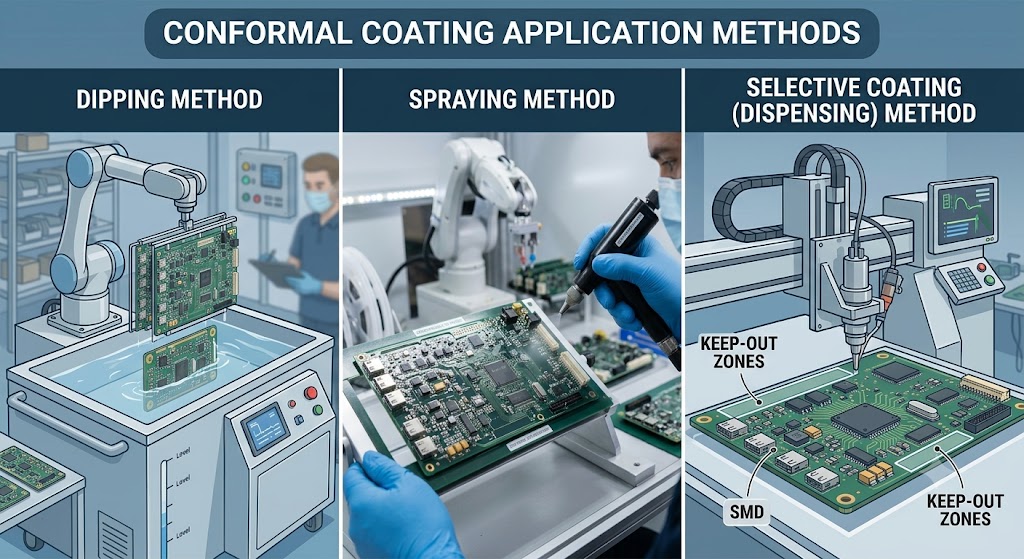
Brush Application
Brush application is most suitable for:
- Prototypes
- Localized repair
- Small production quantities
- Recoating after rework
Main risks include:
- Operator variation
- Brush marks
- Entrapped air
- Uneven thickness
- Contaminated tools
Manual Spray
Manual spray provides more flexibility than brushing and can be practical for low-volume production.
Process controls should include:
- Spray pressure
- Nozzle condition
- Distance from the PCB
- Pass speed
- Spray angle
- Material viscosity
- Operator training
- Overspray control
Manual spraying generally requires substantial masking because the spray pattern is less precise than selective automated coating.
Dip Coating
Dip coating can cover both sides and reach difficult areas efficiently.
The process must control:
- Immersion speed
- Dwell time
- Withdrawal speed
- Material viscosity
- Board orientation
- Drain time
- Mask integrity
Dip coating may be unsuitable for assemblies with many connectors, sensors or cavities because coating can enter areas that are difficult to protect.
Automated Selective Coating
Selective coating equipment follows a programmed path and applies material to defined areas.
Potential advantages include:
- Repeatable coverage
- Better material utilization
- Reduced manual masking
- Controlled flow
- Easier recipe storage
- Scalability for higher volume
The process still requires:
- Correct board registration
- Program revision control
- Valve maintenance
- Flow verification
- First-article approval
- Inspection around tall components
- Control of coating spread after application
Automated application does not eliminate the need for visual or UV inspection.
Parylene Vapor Deposition
Parylene is applied inside a vacuum-deposition system. Because the material is deposited as a vapor, masking must be completed before the process begins.
The method may suit high-value products requiring thin, consistent coverage, but it normally involves higher setup cost and longer processing time than liquid coating methods. (Specialty Coating Systems)
Application Method Comparison
| Method | Best suited for | Repeatability | Masking requirement | Main advantage | Main limitation |
|---|---|---|---|---|---|
| Brush | Prototype and repair | Low | Low–medium | Simple setup | Operator variation |
| Manual spray | Low-volume production | Medium | Medium–high | Flexible | Overspray and variable thickness |
| Dip | Simple board geometry | Medium | High | Broad coverage | Coating intrusion |
| Selective coating | Medium/high volume | High | Low–medium | Controlled pattern | Programming and equipment cost |
| Vapor deposition | Specialized assemblies | High | High | Thin, uniform coverage | Cost, masking and rework |
Curing and Process Control
The cure mechanism depends on the coating formulation.
Common methods include:
- Solvent evaporation
- Heat cure
- Moisture cure
- UV cure
- UV plus secondary moisture cure
- Two-component chemical cure
Tack-Free Does Not Mean Fully Cured
A coating can feel dry while still developing its final properties.
Production documentation should distinguish between:
- Surface dry
- Tack-free
- Handling cure
- Full cure
- Final qualified properties
Packaging, testing or environmental exposure should not begin solely because the coating feels dry.
Parameters to Control
A documented coating process may include:
- Material manufacturer
- Product code
- Lot number
- Expiration date
- Storage temperature
- Viscosity
- Dilution ratio
- Pot life
- Booth temperature
- Humidity
- Spray pressure
- Nozzle type
- Flow rate
- Application speed
- Wet-film thickness
- Cure time
- Cure temperature
- UV intensity
- Conveyor speed
Process data should be tied to the PCBA part number, revision and production lot.
How to Inspect Conformal Coating
Visual Inspection
Normal-light inspection can identify:
- Missed areas
- Runs
- Sags
- Pooling
- Cracking
- Peeling
- Contamination
- Foreign material
- Coating in keep-out zones
- Mask-removal damage
Inspection lighting, magnification and acceptance criteria should be defined in the work instruction.
UV Fluorescence Inspection
Many coatings include a tracer that fluoresces under UV light. This can make it easier to identify coverage and missed areas.
UV fluorescence does not automatically prove:
- Correct film thickness
- Full cure
- Adhesion
- Electrical performance
- Environmental resistance
It is a coverage inspection method, not a complete qualification test.
Thickness Measurement
Thickness can be monitored using:
- Wet-film gauges
- Test coupons
- Witness boards
- Micrometer comparison
- Dry-film measurement equipment
- Destructive cross-sectioning when required
Measurements should be taken at representative locations rather than only on an easily accessible flat area.
The acceptable thickness must follow the approved material specification and customer requirements. A single thickness limit should not be applied to every resin chemistry.
Adhesion and Electrical Verification
Additional checks may include:
- Adhesion testing
- Insulation-resistance testing
- Leakage testing
- ICT
- Functional testing
- Connector verification
- Sensor verification
- RF performance testing
SHDC’s article on in-circuit testing versus functional testing explains why structural electrical checks and product-function verification serve different purposes.
For inspection strategy, see what automated optical inspection can detect. AOI may support pre-coating PCBA verification, but it cannot replace coating-specific coverage, thickness and cure inspections.
Common Conformal Coating Defects
| Defect | Typical appearance | Possible causes | Process checks |
|---|---|---|---|
| Bubbles | Air pockets in film | Entrapped air, high viscosity, rapid application | Mixing, pressure, viscosity and cure |
| Voids | Local missing coverage | Shadowing, contamination, poor wetting | Cleanliness and application path |
| Dewetting | Coating pulls away | Oil, silicone or incompatible surface | Cleaning and compatibility |
| Cracking | Visible fractures | Excess thickness, thermal stress, incorrect cure | Thickness and cure record |
| Delamination | Film separates from surface | Contamination, poor adhesion, incomplete cure | Cleaning and adhesion |
| Pooling | Excess coating in local area | High flow, slow movement or board geometry | Flow and path |
| Orange peel | Textured surface | Atomization, viscosity or solvent issue | Pressure and spray distance |
| Overspray | Coating in prohibited area | Masking or program error | Masking and machine path |
| Under-coating | Insufficient film or coverage | Low flow, high speed or poor access | UV inspection and thickness |
| Incomplete cure | Soft or tacky film | Insufficient UV, heat, moisture or time | Cure parameters |
A defect should not be corrected by adding more coating until the cause has been identified. Applying another layer over contamination or uncured material can make the condition worse.
First-Article Approval and Production Control
Before mass production, the first coated assemblies should be evaluated for:
- Correct material
- Correct board revision
- Coating boundaries
- Keep-out zones
- Masking accuracy
- Coverage
- Film thickness
- Cure status
- Visual appearance
- Electrical function
- Reworkability
- Traceability
The approved application recipe should then be revision-controlled.
Ongoing production monitoring may include:
- First-pass yield
- Coating-defect rate
- Masking-defect rate
- Rework rate
- Thickness trends
- Cure failures
- Material usage
- Equipment program revision
- Material lot traceability
A broader PCB assembly quality control plan can help OEMs define how incoming inspection, in-process control, electrical testing and final inspection connect to coating verification.
What US OEMs Should Include in a Conformal Coating PCB RFQ
A useful RFQ package should include:
- Gerber or ODB++ files
- BOM
- Pick-and-place data
- PCB assembly drawing
- Coating drawing
- Approved coating material
- Approved alternatives
- Coated side or sides
- Coating boundaries
- Keep-out areas
- Required thickness
- Cure requirements
- Inspection method
- Applicable IPC or customer standard
- Electrical testing after coating
- Environmental test requirements
- Rework permission
- Traceability requirements
- Pilot quantity
- Annual forecast
- Packaging requirements
For a complete sourcing-data checklist, see the PCBA manufacturer Vietnam RFQ checklist.
Questions to Ask a Potential Manufacturer
- Is coating performed in-house or by a qualified subcontractor?
- Which coating chemistries and material brands are available?
- How is PCB cleanliness verified before coating?
- How are no-coat areas controlled?
- Which application method will be used?
- How is thickness measured?
- How is full cure verified?
- Is UV coverage inspection performed?
- How are bubbles, dewetting and overspray handled?
- Can material and process records be traced to the production lot?
- How is rework controlled?
- Does a material or process change require customer approval?
These questions should be part of the wider evaluation of a PCBA factory in Vietnam, especially when environmental reliability is critical.
Conformal Coating Requirements and SHDC’s PCBA Process
SHDC Electronics’ company profile describes an EMS scope covering component soldering, assembly, testing and final packaging. Its documented current production scope includes four high-speed SMT lines, three DIP lines, one assembly line, one test line and one packaging line.
The profile also lists Yamaha solder-paste printing and placement equipment, 3D SPI, 3D AOI, an N2 reflow oven, wave soldering, ICT and functional-testing equipment. Its published process flow includes IQC, warehousing, printing, mounting, reflow, AOI, repair, ICT, FCT, OQC and packaging.
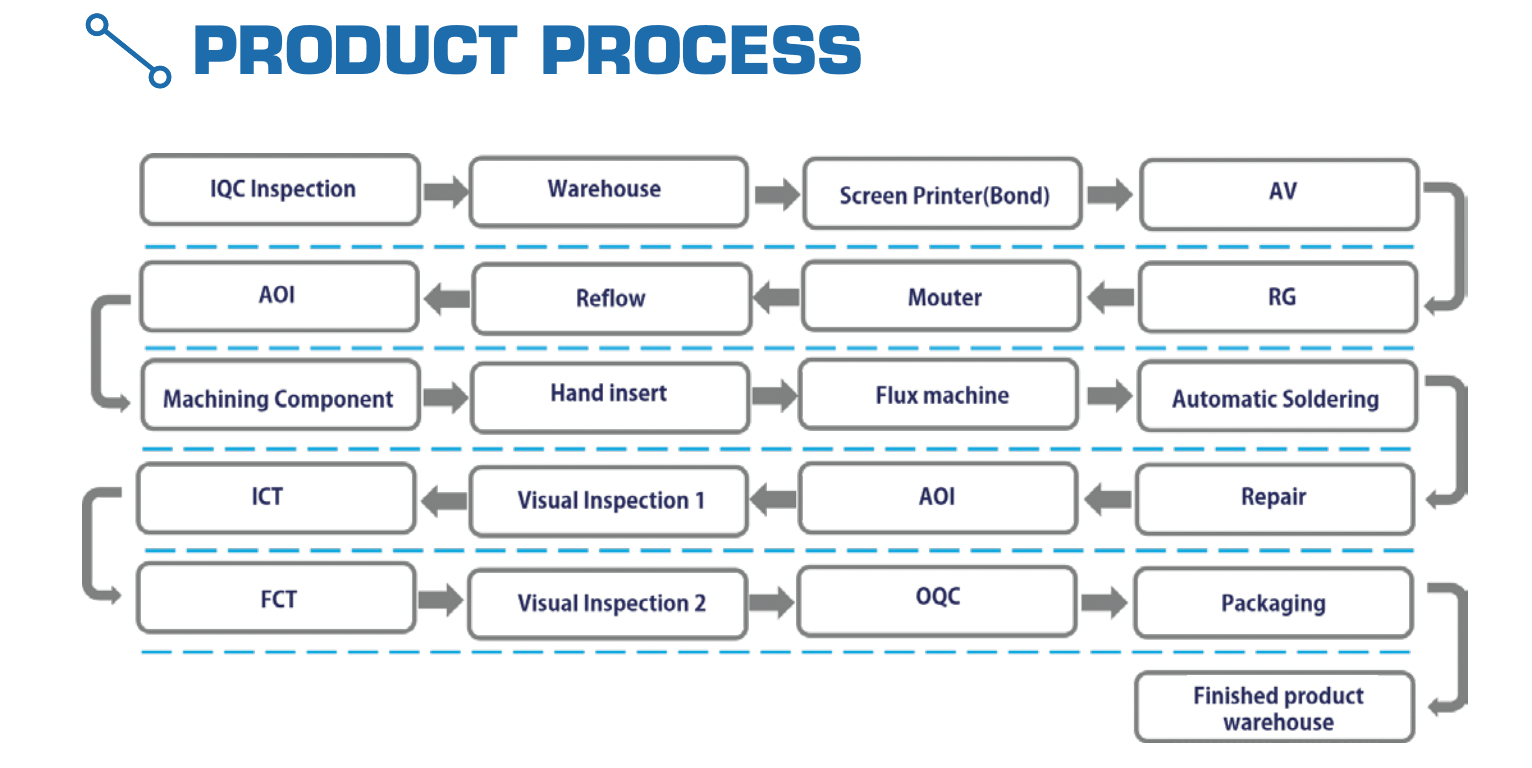
These capabilities are relevant to conformal coating because the PCBA should be inspected and electrically verified before the coating is applied.
However, the supplied SHDC profile does not specifically list:
- A conformal coating production line
- A selective coating machine
- UV curing equipment
- UV coating inspection
- In-house parylene deposition
For this reason, coating material, application method, inspection plan and whether the process is completed in-house or through an approved partner should be confirmed during the RFQ and engineering-review stages.
US OEMs considering Vietnamese production can also review SHDC’s guide to choosing an EMS partner in Vietnam.
>>>Read more: SHDC – Trusted Non-China PCBA Manufacturer in Vietnam for U.S. OEMs
Conformal Coating PCB Checklist Before Production
Before releasing a coated assembly into mass production, confirm that:
- The operating environment is documented.
- The coating material is approved.
- Component compatibility has been reviewed.
- PCB cleanliness requirements are defined.
- Coated areas appear on the assembly drawing.
- Keep-out areas are clearly identified.
- Masking materials and fixtures are approved.
- Application parameters are documented.
- Film-thickness limits are established.
- Cure conditions are validated.
- Visual and UV inspection requirements are defined.
- Electrical testing after coating is specified.
- Acceptance criteria are agreed.
- Rework and recoating instructions are approved.
- Material and process traceability are available.
- First-article results have been approved.
Conclusion
A reliable conformal coating PCB process is not created by selecting a resin and adding one more operation at the end of the assembly line.
Effective coating begins with a clear understanding of the product environment. The OEM must then select compatible materials, identify coating and no-coat areas, define cleanliness requirements and approve an application method.
During production, the manufacturer must control masking, material condition, film thickness, cure parameters, inspection, electrical testing and traceability.
For US OEMs, the most useful RFQ instruction is not:
Apply conformal coating.
A more effective specification defines:
- Why the board requires protection
- Which areas must be coated
- Which areas must remain uncoated
- Which material is approved
- How the coating will be cured
- How coverage and thickness will be inspected
- Which qualification and acceptance criteria apply
That level of detail reduces quotation uncertainty, prevents production disputes and creates a measurable process from pilot build through mass production.
Frequently Asked Questions About Conformal Coating PCB
What is conformal coating on a PCB?
Conformal coating is a thin electrical-insulating polymer applied to a completed PCB assembly. It follows the contours of the board, solder joints and selected components to reduce exposure to humidity, contaminants, corrosion and surface leakage.
Does every PCB need conformal coating?
No. The decision depends on operating environment, enclosure design, voltage, expected product life, repair requirements and the consequences of field failure.
Which conformal coating material is best?
There is no single best material for all products. Acrylic, silicone, polyurethane, epoxy, parylene and UV-curable coatings offer different balances of chemical resistance, flexibility, cure speed and reworkability.
Is conformal coating waterproof?
Not automatically. It can improve moisture resistance, but complete protection also depends on coverage, film integrity, connectors, enclosure design and product-level validation.
Should a PCB be cleaned before coating?
Cleanliness must be evaluated before coating. Flux residue, moisture, oils and ionic contamination can reduce adhesion or contribute to corrosion and electrical leakage beneath the film.
Which PCB components should not be coated?
Connector contacts, test points, sensors, switches, displays, optical surfaces, edge fingers, antennas and mechanical mating surfaces commonly require evaluation or masking.
How is conformal coating inspected?
Inspection may include normal-light visual inspection, UV fluorescence, film-thickness measurement, adhesion checks and electrical or functional testing.
Can conformal coating be removed for repair?
Some coatings can be removed locally, but difficulty varies by chemistry. Acrylic is often easier to rework than polyurethane, epoxy or parylene.
What causes conformal coating bubbles?
Common causes include trapped air, excessive viscosity, incorrect spray settings, rapid application and unsuitable cure conditions. Acceptance depends on the bubble’s size, location and effect on coverage.
What information should be included in a conformal coating RFQ?
The RFQ should define the material, coated surfaces, keep-out areas, film thickness, cure conditions, inspection method, testing requirements, rework rules, volumes and traceability expectations.
>>You Might Be Interested In
PCBA Vietnam: High-Reliability PCB Assembly Partner for US OEMs
Automotive PCBA Vietnam | Trusted Non-China Manufacturer for USA
